|
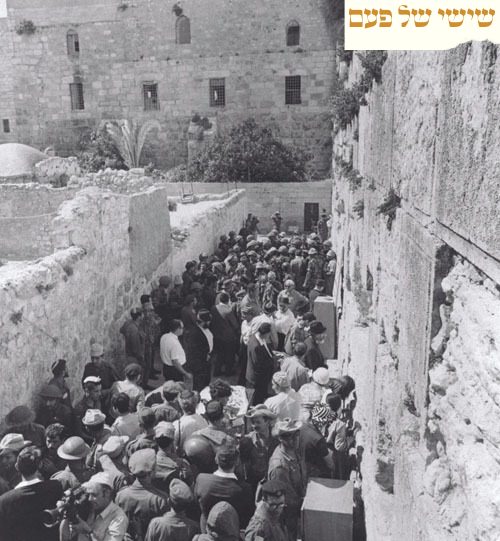
The Western Wall after the Liberation of Jerusalem, June 1967, In this photo, taken two days after the liberation of Jerusalem during the Six-Day War, we see the Western Wall as it appeared before the expansion of the plaza we know today. The narrow alleyway, about 28 meters long and only 3.6 meters wide, was situated in the heart of the Muslim Mughrabi Quarter. For hundreds of years, this was the only access point for Jews to their holiest site—under strict limitations and without the ability to install a partition or place benches for prayer. The Western Wall is the western retaining wall of the Temple and the closest point to the Holy of Holies. It is an external remnant of the Second Temple. Its total length is about 488 meters, and its original height was 60 meters—today, only 40 meters are visible above ground. In June 1967, with the liberation of Jerusalem during the Six-Day War, the situation changed dramatically. Three days after the fighting ended, a decision was made to evacuate the Mughrabi Quarter and establish a plaza to allow worshippers dignified and accessible entry to the Wall. The Mughrabi Quarter, along with the adjacent Jewish Quarter, had been destroyed by the Jordanians, who ruled East Jerusalem until the city’s reunification. These neighborhoods had become neglected, decaying slums built over ruins. The move to clear the area was carried out swiftly to enable large crowds to come and pray, especially with the holiday of Shavuot approaching. The new plaza, covering an area of about 7.5 dunams (approximately 1.85 acres), has since served as a central place of prayer and a focal point for both national and religious events—from the Birchat Kohanim and Bar Mitzvahs to the swearing-in ceremonies of IDF soldiers and the opening of Memorial Day events for Israel’s fallen soldiers. The Western Wall, a remnant of the Second Temple, has become a national symbol and a pilgrimage site for Jews from around the world. The expansion of the plaza greatly improved prayer conditions and symbolized the Jewish people’s return to their holiest site. No longer a “Wall of Tears,” a symbol of destruction surrounded by dilapidated homes, sewage, and garbage—but a powerful declaration that the Jewish people have returned home. On this upcoming Jerusalem Day, 58 years later, we remember the long journey we’ve taken—from the narrow, crowded alleyway, through the emotional moments of the city’s liberation, the soldiers and civilians who gave their lives for the reunification of the most unique city in the world, and the immense privilege we’ve been granted to once again pray at what is the beating heart of all the Jewish people, wherever they may be. “If I forget you, O Jerusalem, let my right hand forget its skill.” A peaceful Shabbat to those far and near. May we be worthy of the sacrifice of those who have fallen—from then until now. May our kidnapped brothers and sisters return swiftly to their families, together with the soldiers of the IDF, and may we merit true unity among ourselves. Photo by: Werner Braun |