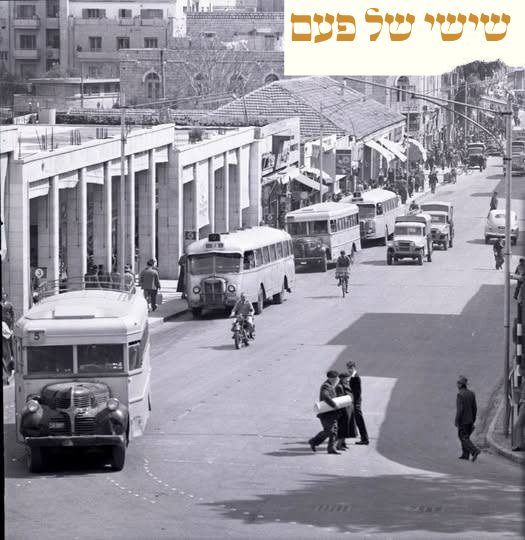
A farewell to the Pillars Building on Yaffo Road – another Once Upon a Time in Jerusalem.
In 1932, Jerusalem’s central bus station was established on Yaffo Road, just south of the famous “X Junction,” on land owned by the Kokia family, together with the “HaMaher” cooperative, from which buses departed to Tel Aviv and Be’er Sheva.
The Pillars Building, constructed between the station grounds and the bustling Yaffo Road, came into being in the aftermath of the bombing of the King David Hotel, a moment that shook the British authorities who ruled the land at the time.
In response, the angered British established secured compounds across the city. Property owners and shopkeepers within these fenced areas were immediately expelled, their properties sealed, and access forbidden.
In their hardship, some of the displaced merchants turned to the Kokia family. Together, they reached an agreement: a 49-year lease on the land, the construction of a row of shops facing the central station, and above them, four floors of offices. At the end of the lease, the merchants would vacate and return the buildings to the family.
The structures were built by contractor Avraham Chasidov. Along the shopfronts, columns were erected, meant to carry the weight of the four planned office floors above.
And so, one of Jerusalem’s iconic landmarks was born, originally named Beit HaAmudim, the Pillars Building, home to Levirer’s pharmacy, Friedlander’s electrical goods store, and many other beloved shops.
But the true highlight, especially for the children of Jerusalem, was the shoe store “Freiman & Bein.” It was the pinnacle of the shopping experience in those days, a type of local Disneyland. Inside stood a wooden bench shaped like a bus, complete with a driver’s seat for trying on shoes, and at its heart, a wooden carousel, the great attraction of the time. Children would spin around on it while the elderly, proper, German-accented saleswomen would disappear into the back to fetch the next pairs.
Generations of children bought their shoes there, the only children’s shoe store in the city, and walked out with shining eyes, a new pair of shoes, and at the end of it all, a balloon on a stick. It was pure, boundless happiness, in a time when people had very little, yet carried a simple, authentic joy. A different world, before Instagram, before social media, before the culture of showing off.
In 1968, the central bus station moved north along Yaffo Road toward the edge of Romema. New shops began to appear, vinyl records of Boney M and Julio playing loudly through speakers, inexpensive clothing stores, and slowly, the area lost its former glory.
The office floors were never built, yet the pillars remained, and with them, the name and identity of the place.
With the construction of the light rail along Yaffo Road, a project that seemed endless, the charm of the area gradually faded, and Yaffo Road became lined with modest, low-cost shops.
Epilogue:
These very days, the Pillars Building complex is being demolished and cleared. Large tractors are removing what remain – the wooden carousel, the echoes of those balloons, making way for the new underground railway station that connects to the central station, known officially as Navon Station. Another long-standing Jerusalem icon gives way to a generation that never knew it, in the name of the city’s growth and ever-expanding life.
This is our Jerusalem –
an underground movement hiding explosives in milk bottles that strike the famous King David Hotel…
merchants expelled, who go on to build rows of shops and dream of office floors that would never rise…
a kind, welcoming shoe seller with a warm smile and a German accent greeting eager children…
a wooden carousel and a red balloon…
a record of Boney M and cassette tapes of Mizrahi music…
cheap clothing stores…
the slow fading of a central artery during the endless construction of the light rail…
and a new underground train to Tel Aviv-
in a city that has never stood still for 3,000 years.
Shabbat Shalom to those far and near from Jerusalem.
Photographer unknown.