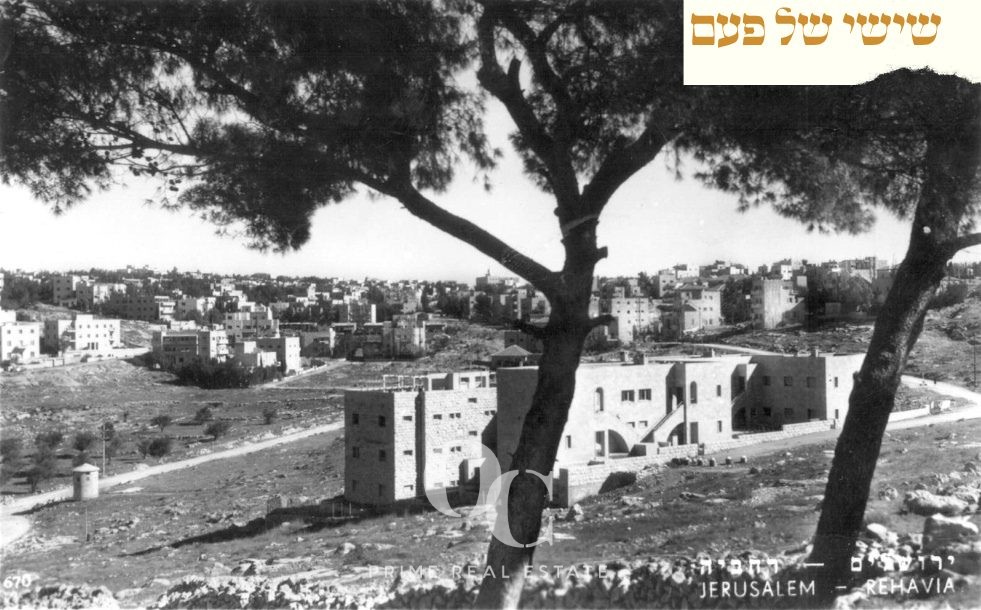
Another Once Upon a Time in Jerusalem – and this time, Beit Kadima.
A building without which our history might have been written very differently.
Beit Kadima is a hidden architectural gem located at 30 HaRav Berlin Street, on the seam between the neighborhoods of Kiryat Shmuel and Rechavia in Jerusalem.
The year is 1945. The British Mandate authorities construct an impressive and luxurious residential complex containing 21 apartments, intended to house the families of senior officers in his Majesty’s Army stationed in the Land of Israel.
But history, as it so often does in Jerusalem, reshuffled the deck. The British realized that their time in the country was limited, and the magnificent structure was left waiting for its true destiny.
In August 1947, just before the great decision, 11 members of the UN Special Committee on Palestine (UNSCOP) were housed at Beit Kadima.
Right here, within these Jerusalem stone walls, in this isolated building secured from all sides, the committee formulated the famous recommendations that ultimately led to the presentation of the Partition Plan at the United Nations and to the dramatic November 29, 1947 resolution: the decision to establish a Jewish state in the Land of Israel.
The building was designed by the renowned architect Otto Hoffman. He masterfully combined the clean, modern International Style (Bauhaus) with unmistakable traditional Jerusalem motifs. The stone cladding, the two distinctive semi-arched staircases on the façade, and the meticulous attention to detail – from the decorative iron railings to the courtyard landscaping and mature trees surrounding the structure.
Already in the 1940s, the building included an innovative laundry room and covered parking at its base, making it a groundbreaking example of advanced planning for its time.
After the United Nations delegation left, Jewish families evacuated from the nearby Katamon neighborhood were housed there. During the War of Independence, Beit Kadima became an isolated frontline position of the Haganah facing Arab bases in Givat Shaheen (the area around today’s NILI and HaTayasim Streets). The building came under fire, and internal passages were even opened between apartments to allow fighters to move safely during attacks.
Today, it is a pastoral, elegant, and beautifully maintained residential complex – a place whose walls are saturated with courage, heritage, and fateful decisions, and which, remarkably, remains relatively hidden from the everyday public consciousness of most of us.
In Jerusalem, buildings and real estate are measured not only by construction quality, but also by the historical story poured into their foundations. Over more than three decades of professional work in the field, the connection between Jerusalem’s architectural heritage and a deep love for the city has revealed time and again that every stone here carries a story, a memory, and a soul.
The well-dressed British officers never got to move into the building and unpack their boxes, but instead, we received the Partition Plan and the dramatic UN resolution of November 29, which led to the establishment of the Jewish state: the State of Israel.
Shabbat Shalom to those near and far from Jerusalem, and a Chag Shavuot Sameach.
The photographer is unknown.