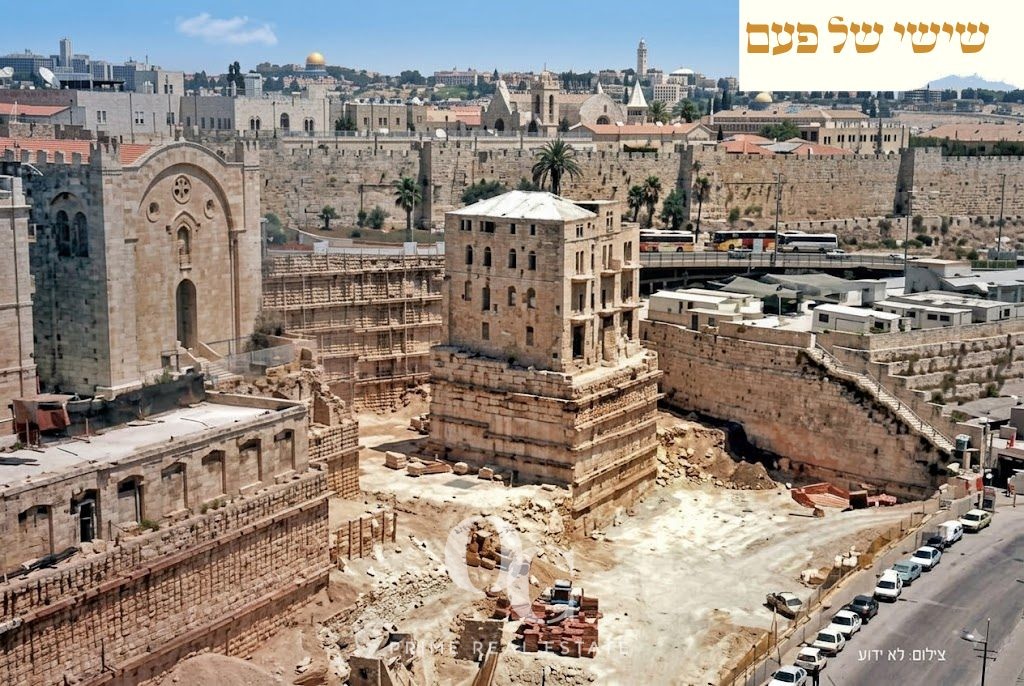
Another Once Upon a Time in Jerusalem – and this time, Mamilla Mall Under Construction, Early 1990s
The Mamilla neighborhood was established at the end of the 19th century as a neighborhood of Jewish and Arab merchants and craftsmen.
Jerusalem’s growing population and the movement of residents out of the crowded and neglected Old City led to the development of an area that was built up piece by piece. It included craftsmen’s workshops, warehouses, garages, and shops constructed in the valley adjacent to Jaffa Gate and the walls of the Old City.
After Israel’s War of Independence, the Mamilla neighborhood bordered the no-man’s-land between Israel and Jordan. It was populated by new immigrants who had only recently arrived in the country and came to be considered an impoverished neighborhood.
At the beginning of 1970, following the reunification of Jerusalem, the idea arose to rehabilitate and develop the neighborhood. Its geographic location was worth its weight in gold, but its physical condition was poor and neglected.
Mamilla was designated a priority rehabilitation area. An area of 100 dunams was expropriated by the Minister of Finance, and in 1971 the Karta Company was established, a government-municipal corporation created for the renewal, rehabilitation, and development of Mamilla and its surroundings.
Following the expropriation, Karta evacuated 345 residential units and 352 shops and businesses, paying 115 million shekels in compensation for the evacuations.
The residents who had lived for years in the neglected neighborhood, directly on the firing line facing the Jordanian Legion, had completed their historic role as cannon fodder. They were compensated for next to nothing, and were relocated to the neighborhoods of Baka and Neve Yaakov.
A master plan was prepared for the neighborhood based on an initial program developed by architects Moshe Safdie and Gilbert Weil. In November 1979, the local planning committee approved a master plan covering 120 dunams in the Mamilla complex.
After years of internal disputes and deliberations in the local and district planning committees, it was determined, quite rightly, that future buildings would not obstruct the view of the Old City walls and that the overall scale of construction would be reduced. The general plan was finally approved in 1981.
In the photograph, Stern House can be seen standing proudly in the middle of the excavation site for what would eventually become today’s Mamilla Mall. The building was designated for preservation and saved from demolition. It was there that Theodor Herzl, the visionary of the Jewish state, stayed for four days during his historic visit to Jerusalem in 1898.
In addition, a new road was constructed through the valley between Jaffa Gate and King David Street. It was later renamed Yitzhak Kariv Street, as it’s known today.
Much water, dust, and concrete flowed during the years of construction. The contractor encountered financial difficulties and stopped working. Another contractor took over, and construction of the parking facility and the valley road was completed at the end of 1978.
In July of that year, Karta issued a tender seeking proposal from a single developer to build the Mamilla project, combining residential, commercial, and hotel space totaling approximately 120,000 square meters.
Karta received proposals from 55 developers. The list was subsequently narrowed to 28, and from those, three foreign developers were selected and asked to submit detailed plans for the project along with their proposed purchase price for the land.
After lengthy negotiations and deliberations, Ladbrokes was selected, a British gambling company controlled by British-Jewish businessman Cyril Stein, who was also chairman of Hilton International.
At the beginning of the 1990s, the company began demolishing the existing buildings, and the first phase of the David’s Village neighborhood got underway.
In 1994, Stein was forced to step down from the management of Ladbrokes following unsuccessful investments in the United States and losses of £230 million.
Ladbrokes began selling assets to cover its losses, and in 1995, Alrov, owned by Alfred Akirov, acquired 50% of the rights to the project. Alrov later completed the acquisition of the remaining rights.
The first phase of David’s Village was completed, and the Hilton Mamilla Hotel, which would later become the David Citadel Hotel, opened in 1998.
The following year, Alrov requested permission to add another 2,000 square meters of commercial space for the construction of movie theaters. The work was delayed because the Karta board, whose majority was religious, opposed the establishment of movie theaters at the site.
At the conclusion of the dispute and following arbitration, Karta was ordered to pay Akirov 102 million NIS, in addition to legal expenses, for the delays that had been caused.
In May 2007, the eastern section of Mamilla Mall opened to the public. The mall was fully completed and opened in its entirety in 2010 – 30 years after the plan had first been approved by the various planning committees.
The government-municipal Karta Company was dissolved in 2012, reminding everyone that the combination of a government company and business entrepreneurship will always end in a deficit – one ultimately covered by the taxpayer.
As part of Karta’s dissolution, a bidding process was issued for the sale of the covered Karta parking garage near Jaffa Gate.
In December 2013, Alrov won the bid to purchase the parking facility for 110 million NIS, along with a commitment not to raise parking prices there for 20 years.
In March 2014, the Antitrust Commissioner disqualified Alrov’s winning bid out of concern that it would create a monopoly over parking facilities in the area, since Alrov already owned the Mamilla and David Citadel parking garages.
Alrov’s appeal against the disqualification was rejected, and the winning bid passed to the second-highest bidder, REIT 1, which had offered 107 million NIS.
Following its acquisition, the fund raised parking prices by 40%. Since then, taxpayers have also been paying 40% more for parking – because at the intersection between government operators and real-estate tycoons, it is always the taxpayers who are assumed to have the deepest pockets from which money can be forcibly taken to cover the mistakes of others.
This is our Jerusalem.
Industrial and commercial areas, garages and warehouses belonging to Jews and Arabs that became the no-man’s-land between Israel and Jordan; new immigrants who were housed in an impoverished neighborhood and for years served as the buffer between Jerusalem and the Old City; people who endured poverty and hardship, only to have their homes seized for minimal compensation.
And one Herzl – the man with the beard – who dreamed of and conceived the idea of a national home for the Jewish people. He spent four days in a small family-run hotel beside the Old City walls, leaning against the balcony railing, never imagining in his wildest dreams what the city and the country would look like 125 years later.
A Shabbat Shalom to those far and near, from Jerusalem.