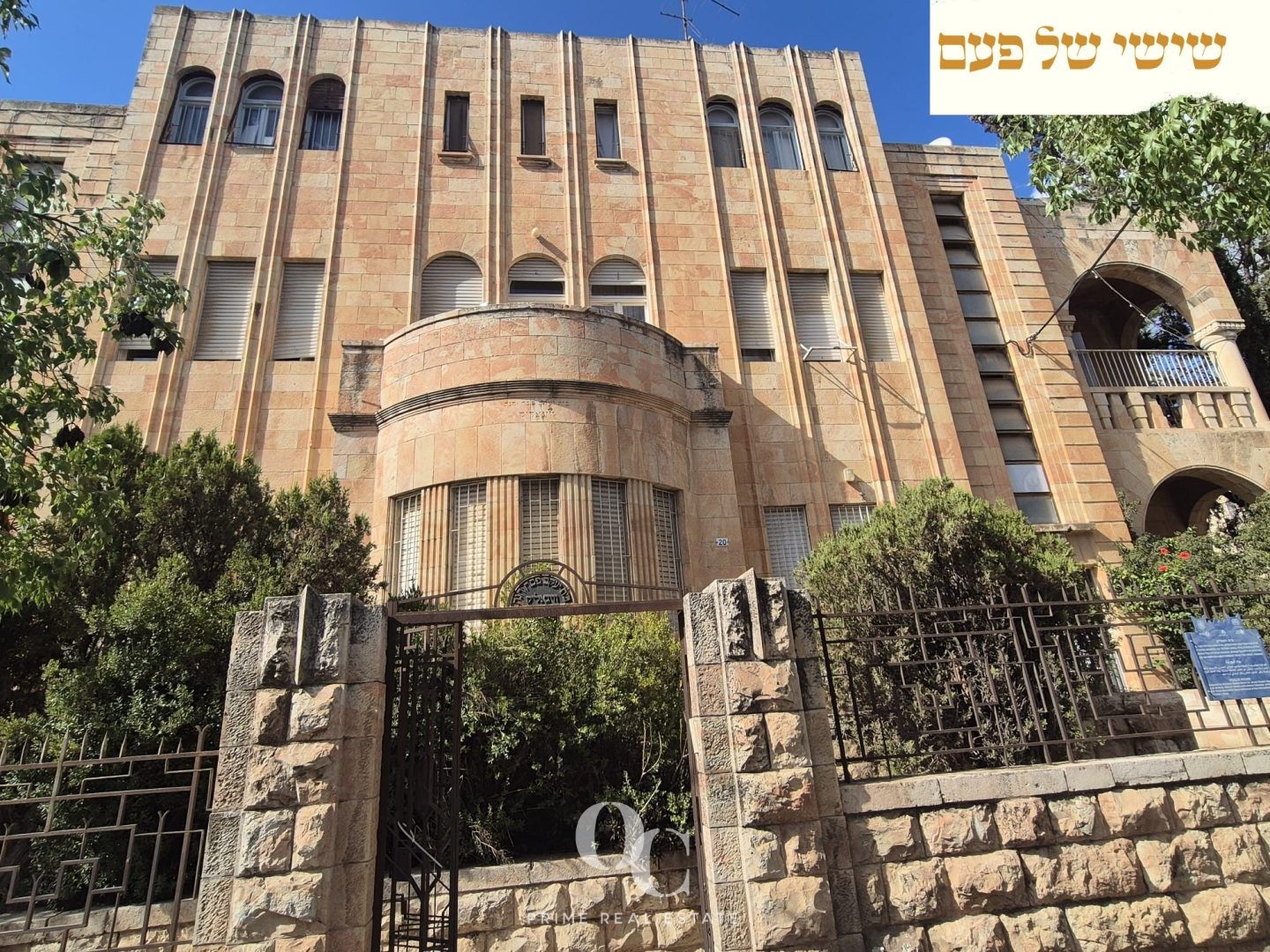
Another Once Upon A Time in Jerusalem – and this time, we’re visiting the building that made Rechavia’s buttoned-up German intellects lower their glasses to the tips of their noses in shock: Beit Vigalik, standing proudly at the corner of 20 Keren Kayemet Le-Israel Street and Ussishkin Street.
If you thought historic Rechavia was built exclusively from the modest, straight-edged concrete blocks of the “International Style,” then you probably haven’t yet encountered the mischievous and surprising architect Nathan Brin, a talented and creative Hungarian Jew, or the building’s original owners, Yaakov Pesach and Chana Vigalik.
Yaakov Pesach was far from your typical Jerusalem contractor. He was an extraordinary philanthropist and a “professional fundraiser” – and a phenomenally successful one at that – who raised donations from wealthy benefactors around the world, particularly on behalf of the Diskin Orphanage.
Since the couple had no children, they decided to channel their energy and resources into what was an ambitious real-estate venture for the 1930s: a luxurious apartment building designed and constructed entirely as a rental property.
Interestingly, they did not reserve the penthouse for themselves. Instead, they lived relatively modestly in the apartment on the left side of the second floor.
When construction was completed sometime around Sivan 5696 (1936), the neighbors must have rubbed their eyes in disbelief.
Architect Brin certainly did not hold back when it came to his palette of colors and materials. He built this small palace from a rare reddish stone known as Mizi Ahmar.
He created an eclectic building that paid little attention to architectural convention: a façade decorated with Neo-Oriental arches, balconies supported by classical columns and capitals, and, as a finishing touch, tall vertical windows running through the stairwell that resemble a thermometer straight out of the International Style. These windows were designed to flood the south-facing staircase with warm Jerusalem sunlight.
To complete the picture in meticulous style, the courtyard was surrounded by an iron fence decorated with Art Deco latticework. On the main entrance gate, the Hebrew letters “תרצ״ו” – 5696, the year construction was completed, were proudly incorporated into the design, alongside the names of Yaakov Pesach and Chana, whose names also appear prominently at the center of the building’s rounded entrance, leaving no room for confusion about whose house this was.
Today, this remarkable and beautiful building has rightfully been designated for preservation and appears on Israel’s list of heritage sites. But Keren Kayemet Street around it looks very different from the street it once was.
The quiet of those days has been replaced by honking cars and traffic jams. Roads were paved, buildings sprouted additional floors and new balconies, and a luxury real-estate office that opened on the opposite corner in 1998 has since become a neighborhood institution.
The days when the building’s residents would head out in the morning to buy milk in an aluminum pail at the corner, or purchase heating kerosene from a horse-drawn mobile cart, have become distant memories – practically legends.
This is our Jerusalem: history constantly in the making.
Old facing new. A world of holiness and charity blending with European architecture and a touch of the Middle East. And one house in Rechavia reminding us that once upon a time, true luxury was built from red stone – and a generous heart.
Shabbat Shalom to those far and near, from Jerusalem.