Another “Once Upon a Time in Jeursalem”,
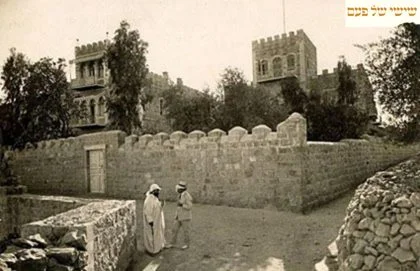
This time, a photo from 1925 of the Bezalel National Rehabilitation House, located on Shmuel Ha-Nagid Street, at the corner of what is now Shatz Street.
The building at 12 Shmuel Ha-Nagid Street was a museum established next to the Bezalel School of Art. Initially, it served as a museum for the history of flora and fauna in the Land of Israel.
The Bezalel School of Art, built nearby, was named after Bezalel ben Uri, who, according to the Book of Exodus, was appointed by God through Moses, along with Aholiav ben Ahisamach, to build the Tabernacle, the Tent of Meeting, the Ark, the Menorah, the Altar, and the sacred items of the Temple.
Boris Schatz, the founder of the Bezalel School, envisioned the possibility of helping Israeli artists combine the natural life of the Land of Israel with their art, creating a blend of contemporary Israeli art with the living world of the Holy Land.
The first public exhibition at the Bezalel Rehabilitation House took place during Passover 1912 and quickly became a focal point for visits by leaders of the Jewish community in the Land of Israel, which was still under Ottoman rule.
In 1916, Djemal Pasha, a senior Ottoman official, visited the place with a retinue that included the Pasha of Jerusalem and other prominent figures.
In 1925, after World War I, the museum opened regularly to the public in the afternoons.
With the opening of the Israel Museum in G’ivat Ram in 1965, the art collection from the building was transferred to the museum and became the foundation of the Israeli Art Department.
With the museum’s closure, the Bezalel Rehabilitation House became an artist’s house, where exhibitions of Israeli artists were held in rotating shows.
Since 2001, the Israeli Biennale for Drawing has been held at the site.
Today, the Bezalel National Rehabilitation House serves as an artist’s house with rotating exhibitions, and the high-quality Mona restaurant has become a popular destination for diners from across the country and the world.
Today, the dirt alley before the wall has become the present-day Shmuel Ha-Nagid Street, and the stone terraces are long gone.
Shmuel Ha-Nagid Street is named after Rabbi Shmuel Ha-Nagid, a Renaissance man who was a rabbi, a halachic authority, a poet, and one of the leaders of Spanish Jewry during the Golden Age. He also served as the deputy to the King of Granada and was the first great Hebrew poet, followed by Rabbi Shlomo Ibn Gabirol, Rabbi Moshe Ibn Ezra, and Rabbi Yehuda Halevi.
Later, Rabbi Shmuel Ha-Nagid was appointed head of the rabbis of Spain.
Our modest contribution to the building of Jerusalem and its ongoing history, right before our eyes on Shmuel Ha-Nagid Street, is being realized with the marketing of two new projects on the street that combine luxury housing while preserving the unique historical character of the area and ensuring the buildings match the existing architectural style, all while maintaining the humility that is appropriate for a city that has lived and renewed itself for 3,000 years.
This is our Jerusalem,
Old alongside new,
the art of creating the Tabernacle and sacred vessels in the Exodus from Egypt, alongside contemporary Israeli artists preserving Jewish art and spiritual life over 2,500 years, alongside beautiful Jewish poetry from the exile of the Jews of Spain to the renewal of the city in modern times.
Bayamim hahem bazman hazeh.
A living and ongoing memory and another link in the generational eternal chain of the People of Israel, taking shape before our eyes.
Wishing a Sabbat of love and peace for all those far and near from Jerusalem.
May all the hostages return swiftly to their homes in peace, along with all the soldiers of the IDF. May we find true unity among us, and have a good and blessed month be renewed upon us.