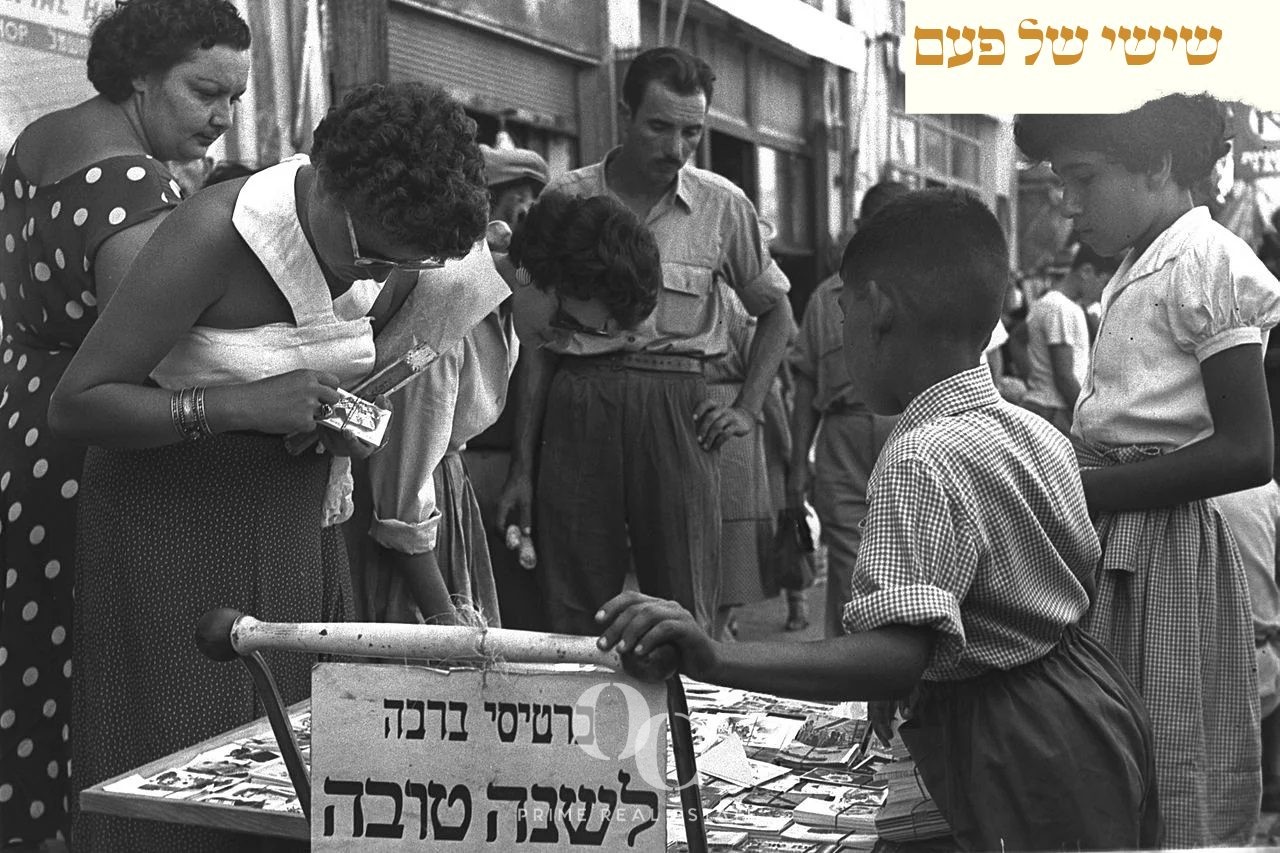
A stall selling Rosh Hashanah greeting cards,1955 – Another Once Upon A Time in Jerusalem.
Rosh Hashanah was always an opportunity to wish family members and Jewish communities everywhere a happy New Year, including relatives and communities in distant places, by sending a postcard or a written or illustrated New Year’s greeting.
The custom began as early as the Middle Ages, when letters were illustrated or written many weeks in advance so that they would reach distant communities on time, before the holiday.
With the invention of the postal card at the end of the nineteenth century, the custom became widespread and easier to observe. Jewish communities throughout the world sent their New Year’s greetings well in advance, as part of the holiday tradition and as a way of preserving their connection to Jewish heritage and to the Land of Israel.
In the Jewish community of Eretz Yisrael, a custom developed of sending Rosh Hashanah greetings featuring illustrations of the Promised Land, portraits of righteous Jewish figures, and familiar biblical scenes to donors and benefactors around the world, in order to encourage support for the renewed Jewish community in the Land of Israel.
During the First World War, Rosh Hashanah postcards were sent depicting Jewish soldiers on the battlefield.
During the Second World War, New Year’s cards featuring rhymes in Yiddish were produced inside the ghettos.
An album containing 32 such postcards was discovered among the ruins of the Warsaw Ghetto after its liberation by the Allied forces.
During the 1940s and 1950s, stalls selling Rosh Hashanah greeting cards became common throughout Israel.
The cards were mass-produced using industrial printing machines and featured scenes from the Land of Israel, the Seven Species, shofars, images of the Western Wall, and illustrations of the dove of peace carrying an olive branch in its beak – the dove everyone is still waiting for.
Apparently, it has yet to find a quiet place to land. Perhaps, during its long journey with the olive branch in its beak, it was caught in a net – or simply turned back after failing to find parking.
With the arrival of the telephone, the custom gradually declined. Once mobile phones entered our lives, Rosh Hashanah cards almost completely disappeared. They were replaced by identical, generic, yet supposedly “personal” greetings sent at the touch of a button to an entire contact list -including the kindergarten teacher of the child who has since joined the army, and “Menashe the Plumber – Do Not Answer.”
Shana Tova and Shabbat Shalom to those near and far, from Jerusalem.
May the old year and its curses come to an end, and may we all be renewed with a good, sweet, peaceful, and blessed New Year.
Photograph: Moshe Friedman – The National Photo Collection.