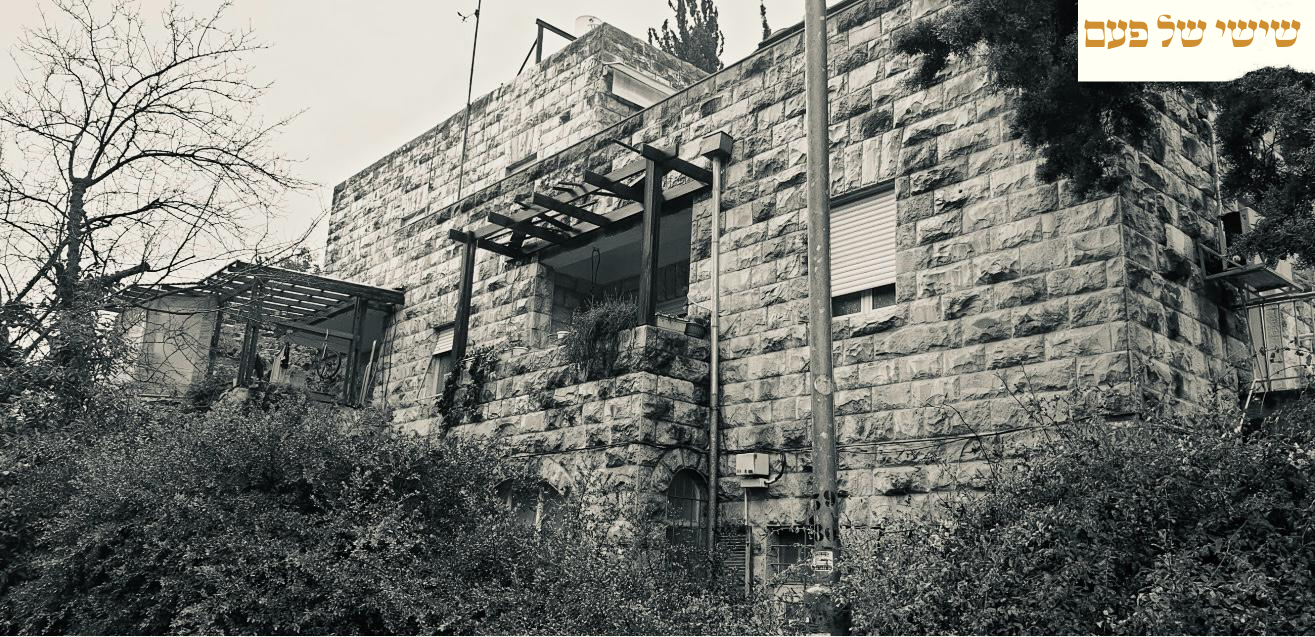
Abraham Kozlov House – 2 Abarbanel Street,
another Once Upon a time in Jerusalem.
In the heart of the Rehavia neighborhood in Jerusalem, among its green and peaceful streets, stands a beautiful building on 2 Abarbanel Street, and the corner of El-Harizi Street,
A typical Jerusalem house that carries with it a rich story of urban and family history.
The house was built in 1924 on one floor by Abraham Kozlov, who purchased the plot on the early 1913.
Kozlov, who was an enthusiastic Zionist back in Russia, was one of the pioneers who came to build in Jerusalem and combined an eclectic style with oriental motifs in the construction of the house, while thinking about every detail and combining the comfort of living with the local inspiration of the Old City.
The house served for decades as a residence for the Kozlov family, and later for the Alprn family, and became a center of family life, community and hospitality.
Alprn, who was an officer in the cavalry of the Russian army, met Yosseph Trumpeldor during the battles, who convinced him to immigrate to Israel. He joined Trumpeldor’s labor battalion in Metula, from there he walked to Tel Hai, and then arrived in Jerusalem and was among the members of the local labor battalion that was based entirely on Hebrew labor.
He joined a group that studied stonemasonry at Bezalel, fell in love with stonework and began, in addition to stonemasonry and the construction of the Rehavia neighborhood, to sculpt sculptures from the Jerusalem stone that was the cladding material for buildings in the city.
In 1934, an exhibition was held at Wembley Stadium in London that included art from all the colonial colonies of the British Empire at the time, and Alfern, who was known as Barada (man with a beard in Russian) because of the thick and long beard he boasted, carved a stone map of the Land of Israel measuring 2 meters by 160, and weighing several tons, which was respectfully transferred to the capital of the British Empire from the colony in Israel and was respectfully displayed at the exhibition.
Later, the family asked to have the map returned to them, but its fate is unknown.
In 1946, an additional floor and a half were added to the house, designed by architect Eliezer Rotskus, while preserving the original character of the building, and under the close supervision of Kozlov.
The green and pastoral Abarbanel Street gave the residents of the house a sense of peace, but also stood witness to the great historical changes that took place in the city.
During the Mandate period, the War of Independence, and the establishment of the state, the house witnessed crucial moments. It served as a refuge during the years of siege, hosted public figures and members of the underground figters, and was also a place of excitement on Independence Day. Family members stood on its balcony, including younger generations who were privileged to see history unfold before their eyes.
Over the years, Pinchas Rosen, who was the first Minister of Justice of the State of Israel, Mr. Lichtheim, who was the chairman of the Association of Jewish Immigrants from Germany, and Chaim Kadmon (Kozlov), who was Avraham’s son and served for decades as the General Guardian of the State of Israel, lived in the building.
On the ground floor, lived the manager of the Yefet Bank who left the country during the War of Independence.
His locked apartment was eventually invaded by Aliza Biginski and her husband.
Aliza, who was one of the heroic women who fought in Gush Etzion until its fall, was one of the only four defenders who remained alive out of 131 settlers and members of the Haganah who survived the heroic battles in Kfar Etzion, and was the first Jewish woman taken prisoner by Jordanian forces.
The fascinating details about the building’s history were told to me by Amnon Ramon, Kozlov’s 91-year-old son-in-law and a resident of the Rehavia neighborhood, who still remembers the details and fascinating history of the building and its residents.
Amnon’s daughter, Dr. Einat Ramon, Avraham Kozlov’s granddaughter and a native of the house, says: “Every wall in the house, every stone and every tree on Abarbanel Street – they are part of my memory. This house is not just a place to live, but a complete life story, both personal and national.”
This is our Jerusalem – a city where a house is not just a beautiful architectural structure made of stone, but a living testimony to the history of Jerusalem, a city where history and the present are intertwined, with the memories of the families who lived there, the struggles of the period and the dreams of the founding generation.
To this day, the house is a symbol of Jerusalem’s rich heritage, a house in which an entire generation grew up, who saw the city take shape and who themselves became an inseparable part of the story of Jerusalem and the revival of the Zionist enterprise and the return of the Jewish people to their home land.
Today, the building is being reinforced and another floor is being built in the historic, corner building, and I have had the privilege of taking part in the sale of the historic apartments that are for sale in it, in a city where every stone tells a story.
From Trumpeldor who met on the battlefield a Russian officer with a large, black beard, who became his trademark, and who immigrated to Israel following the meeting, to Koznov, who had a Zionist spark burning in him and left Russia for the benefit of the Land of Israel under Ottoman rule, which built a building for him and his family, which housed the Minister of Justice and the first Jewish captive in the Land of Israel that had not yet been established, and the story that is still emerging day by day in an ongoing history that is in fact the wonderful story of the Zionist enterprise.
Shabbat Shalom to near and far, K’tiva V’echatima Tova.
May the kidnapped brothers return soon ,may the wounded heal and all our soldiers return in peace, and may peace come to Israel.