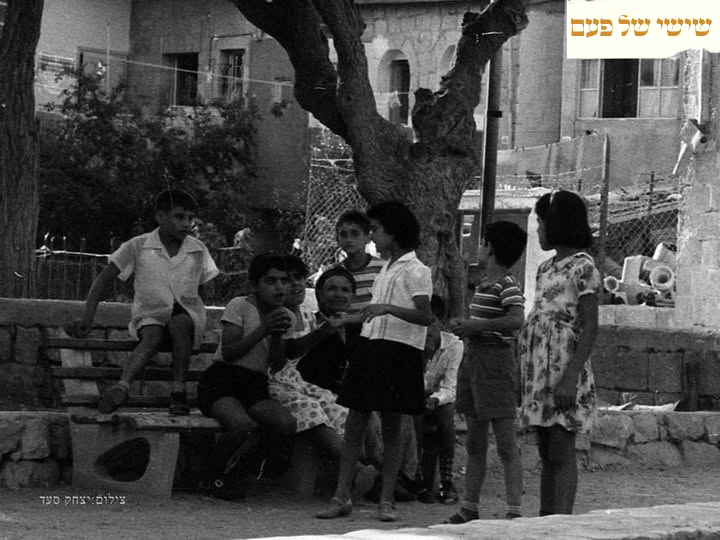
Another “Once Upon a Time in Jerusalem”
This time – Gan HaTut (Mulberry Garden), Ohel Moshe Neighborhood, Nachlaot, late 1960s.
Gan HaTut was built at the end of the 19th century as the center of the Ohel Moshe neighborhood – one of the first Jewish neighborhoods built in the Nachlaot area.
The garden got its name from the large mulberry trees that have stood there for many years. Scattered around the garden are several water cisterns, which served the neighborhood’s residents and its surroundings until the 1930s.
These cisterns supplied water to the besieged city during the War of Independence, and the garden, located at the heart of the neighborhood, was the meeting point for residents – a kind of local community hearth.
The small houses of the neighborhood opened onto the spacious courtyard with the mulberry trees and served as the communal center – a gathering place for residents and children, where women would come together on laundry day with tubs of hot water and washboards to scrub the dirty clothes. It was also a gathering spot on Shabbat and holidays after prayers at the synagogue.
Among the residents were legendary Jerusalem figures for whom Gan HaTut is forever etched in memory.
Yitzhak Navon, who would later become President of Israel, wrote The Sephardic Orchard inspired by the garden, with the story unfolding around it.
The great Yossi Banai, another resident of the neighborhood, wrote in his memoirs:
“I return to the neighborhood, to the mulberry tree, to the red, red kite tied to a string, alongside Simon and little Moiz.”
Over the years, the neighborhood was neglected. Longtime residents preferred to move to housing projects and new buildings in the growing city, and in the 1970s and 1980s, the garden became frequented by drunks, addicts, the homeless, and eccentric individuals afflicted with the “Jerusalem Syndrome.”
The garden turned into a rundown place with worn-out benches. Mulberry fruits littered the ground, uncollected, and skinny, hungry cats roamed around. It became a gathering place for the city’s oddballs.
In the 1980s, the municipality launched a Neighborhood Renewal Project in Nachlaot, in collaboration with local residents.
Renovations were slow, but sidewalks were built, alleyways repaired, and gradually young people, students, and new residents began to return to this unique neighborhood with its familiar Jerusalem charm.
The members of Hadag Nahash, the band so closely associated with Jerusalem, moved into the neighborhood and wrote in their song Gan HaTut:
“Two religious guys gambling away what they don’t have,
A female Border Police officer crushed in the June heat,
A Bezalel student with a camera looking spaced out.
This is the nearby garden – Gan HaTut.
Just walking into it drains my energy.”
Over time, the neighborhood developed. Streets were organized, and a new population from Israel and abroad, searching for the old-time Jerusalem character, moved in. The houses were renovated and upgraded, and the charm and grandeur returned to this most Jerusalem of neighborhoods.
In 2009, after a long battle by the residents demanding its restoration, the garden was finally renovated and renewed. Today, the garden is clean, orderly, and open to anyone wanting to feel what the original neighborhood once felt like.
So when Friday arrives, and the old religious man from Gan HaTut is just locking up his shop, you can allow yourself to indulge in the nostalgia of days gone by — in the most special city in the world.
Shabbat Shalom to those far and near from Jerusalem ❤️
May all IDF soldiers return home safely, along with our kidnapped brothers, and may peace come upon Israel.
Photo courtesy of the Yitzhak Saad z”l photo collection