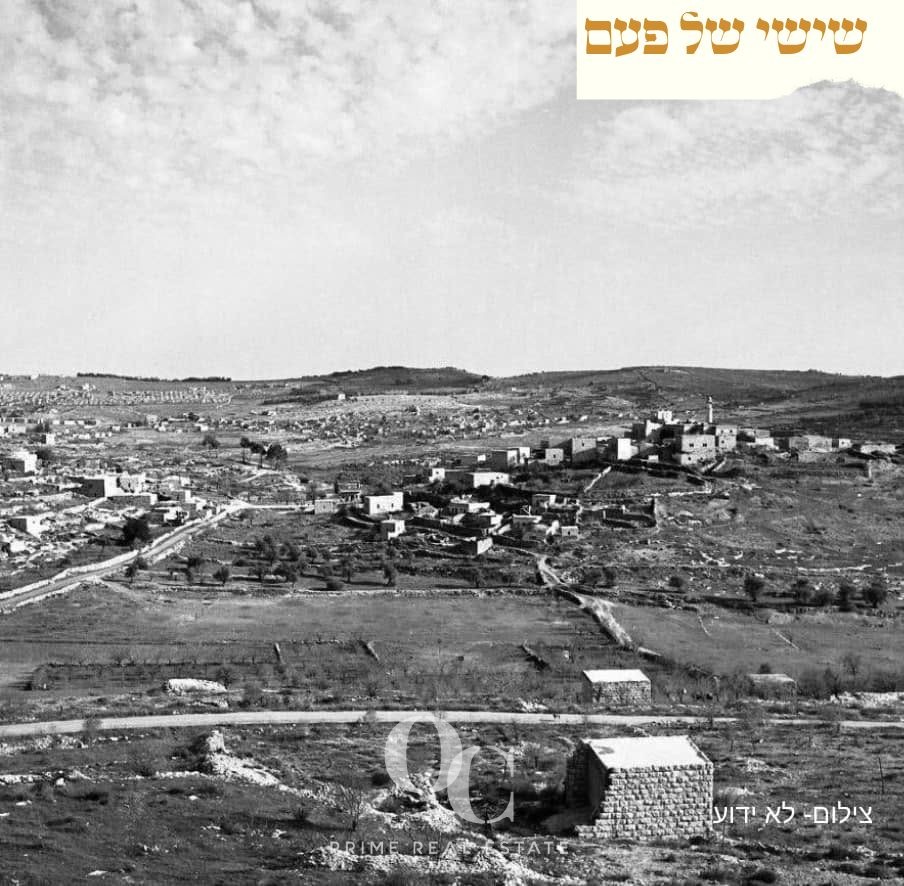
Malha – the 1930s.
Another Once Upon a Time in Jerusalem.
Almost everyone knows the Malha neighborhood – the mall, Teddy Stadium, or Pais Arena Jerusalem. But in Jerusalem, as in Jerusalem, every building tells a story, and every stone rolls through history from the distant past to our own time.
There is evidence of the original Malha neighborhood dating back to the 6th century CE, with Jewish settlement there. Alongside them, Georgians who came from afar settled in the area and cultivated rose gardens.
Later, in the 12th century, in addition to the small Jewish community, Georgian monks also lived in the village. They served at the monastery in the Valley of the Cross and worked the surrounding agricultural lands.
Later still, in the 16th century, the Arab Darwish clan took control of the village and nearby settlements.
With the return of Jewish settlement to the Land of Israel, the lands in the area were purchased by the land merchant and Rabbi Nissim Elishar, and ownership returned to Jewish hands.
The Arab residents of the village of Al-Malha (“the salty one”) took part in attacks on the neighboring Jewish neighborhood of Bait Vegan during the 1929 riots. Due to the village’s strategic location and its control over the nearby railway line, it became a base for Arab fighters from the surrounding region, who launched attacks on nearby Jewish neighborhoods. They were joined by forces from Yemen and Jordan – long before the Houthis became known to the world.
After the first truce in the War of Independence, it was decided to capture the village. On July 14, 1948, the village was taken by fighters of the Irgun.
The next day, the Arabs launched a counterattack, in which 18 Irgun fighters who had captured the village the day before were killed.
After the village was secured, the Arab forces withdrew. In memory of the fallen, a memorial was held on Golomb Street, bearing the names of those killed.
The Arab residents of the village and neighboring villages abandoned their homes during the War of Independence.
In June 1949, the abandoned homes were settled by immigrants from Tunisia, Kurdistan, and Morocco. The village was designated a workers’ settlement and received livestock and farming equipment from the Jewish Agency for Israel.
Later, the Agency claimed the area would soon become an urban settlement and took back the agricultural equipment.
Living conditions in the neighborhood were harsh, and the residents were forced to sell their goats and begin working as laborers and independent tradespeople.
Only in 1953 was the village officially annexed to Jerusalem, and it was connected to the electrical grid only in 1959.
After the Six-Day War, artists and members of Jerusalem’s bohemian scene began to take interest in the village, drawn by its preserved Arab houses and its narrow, enchanting alleyways. A process of restoration and renovation began.
The neighborhood’s major transformation came in the 1980s, when the old village expanded into a neighborhood of villas and homes. The sports arena was built, followed later by the mall, the technology park, and the old railway station.
This is our Jerusalem –
In the rose gardens, a mall grew.
The carts of the Georgian monks on their way to the monastery in the Valley of the Cross were replaced by the luxury cars of Jerusalem’s wealthy.
On the sniper posts that once fired at Bait Vegan, a sports arena was built, where Adi Gordon once took his shots.
And near the village rose the technology park, home to Israeli-made innovation in high-tech, banking, and academia.
And if the 18 Irgun fighters who fell in the battle for the village could see what has become of it…
Zionism, settlement, and the renewal of the Zionist enterprise upon the ruins of a village founded back in the 6th century CE – in a city where every stone tells a story of continuous history.
A Shabbat Shalom to those near and far, from Jerusalem.
(The photographer is unknown.)