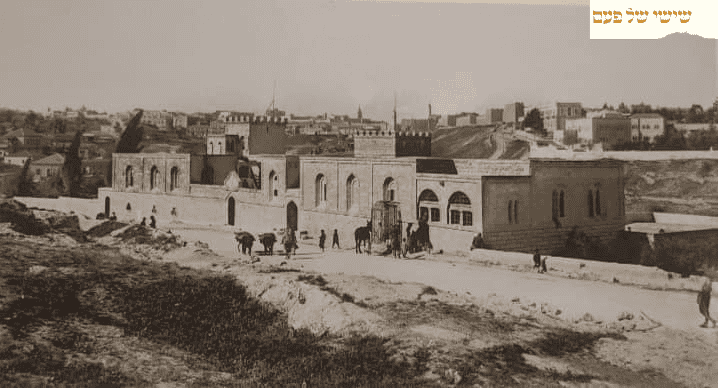
Another “Once Upon a Time in Jerusalem” – and this time, the Mount Zion Hotel, in a photo from the early 20th century.
The hotel is situated above the basin of the Old City, above what is today the Cinematheque building. It overlooks the Old City walls, the Sultan’s Pool, and the Valley of Hinnom – near Mishkenot Sha’ananim and facing today’s new Begin Heritage Center.
The front facing the road seen in the photo is the beginning of what is now Hebron Road, without traffic jams, taxis, buses, or smoke-filled transit vans carrying workers from East Jerusalem.
Those were the days…
The building was originally constructed in 1882 as an eye hospital founded by members of the British Order, under the patronage of Queen Victoria and her son, Edward VII, Prince of Wales. After considerable effort, they succeeded in persuading the Turkish ambassador in London—during the time when the Ottoman Empire ruled the land—to approve the establishment of the hospital.
The poverty, low hygiene standards, and overcrowding in late 19th-century Jerusalem contributed to the prevalence of eye diseases.
After the clinic opened, word spread throughout the region. Patients began arriving at the eye hospital from the Old City, Jaffa, and Nablus, and even as far as Tiberias, Damascus, and Petra in Jordan.
According to reports, around 80 patients were treated daily at the clinic in 1882.
The hospital became a central hub for eye treatment and was a rare cross-religious consensus project, supported by the Turkish governor of Jerusalem, the Greek Patriarch, the Armenian Patriarch, and the city’s rabbi at the time.
By the end of 1888, the hospital was treating 58,000 patients a year and performing about 900 surgeries.
But in Jerusalem, as in Jerusalem, there’s never a dull moment.
During World War I, the hospital was shut down and converted into a munitions warehouse by the Turkish army.
After the British conquest of Jerusalem, the Turks were ousted, and the former hospital building became the headquarters of the London Division’s commanding officer.
At the end of 1919, the headquarters was evacuated, the hospital resumed operations, and due to overwhelming demand, a new wing was built across the road — today’s “Beit Ot HaMuzar” (Craftsmen House) — connected via a tunnel beneath the road.
The hospital operated until 1948, when it was transformed into a Haganah (Jewish defense forces) position. A cable car was installed there, running over the Valley of Hinnom to Mount Zion, used to transport weapons, equipment, and supplies.
After the war and the end of fighting, the Netiv Meir Yeshiva was established in the building, though it later relocated to the Bayit Vagan neighborhood.
In 1964, the Israel Lands Authority purchased the building and sold it in 1972 to a private entrepreneur.
The developer planned to demolish the entire structure, and after destroying the southern and central wings, a struggle led by conservation and environmental groups succeeded in halting the demolition, restoring and preserving the building, and transforming it into a hotel in 1986.
In December 2019, the Azrieli Group purchased the hotel and land for 265 million NIS from the Eliyahu and Shechter families, who had owned it until then.
Today, the entire complex is fenced off and undergoing massive construction. The old buildings — which witnessed history unfold through inflamed eyes — will be preserved and restored and will form part of a future hotel complex.
This is our Jerusalem —
A British hospital built during Turkish rule, that served patients of all faiths, from Damascus to Jordan and Gaza, later becoming a Turkish headquarters, then a British one, then a Haganah outpost in the War of Independence, later a yeshiva, then seized by a greedy entrepreneur — but saved in time by people of moral and architectural conscience. It became a hotel, which was then bought, and will now be renovated, preserved, and expanded.
A city and its stones, which have witnessed changing regimes, Zionist revival, and much blood and tears — all seen through red eyes.
A 150-year time machine in overdrive.
A peaceful Shabbat to all far and near from Jerusalem.
May the hostages return home quickly, along with the IDF soldiers, and may peace come upon Israel.
Photographer unknown.