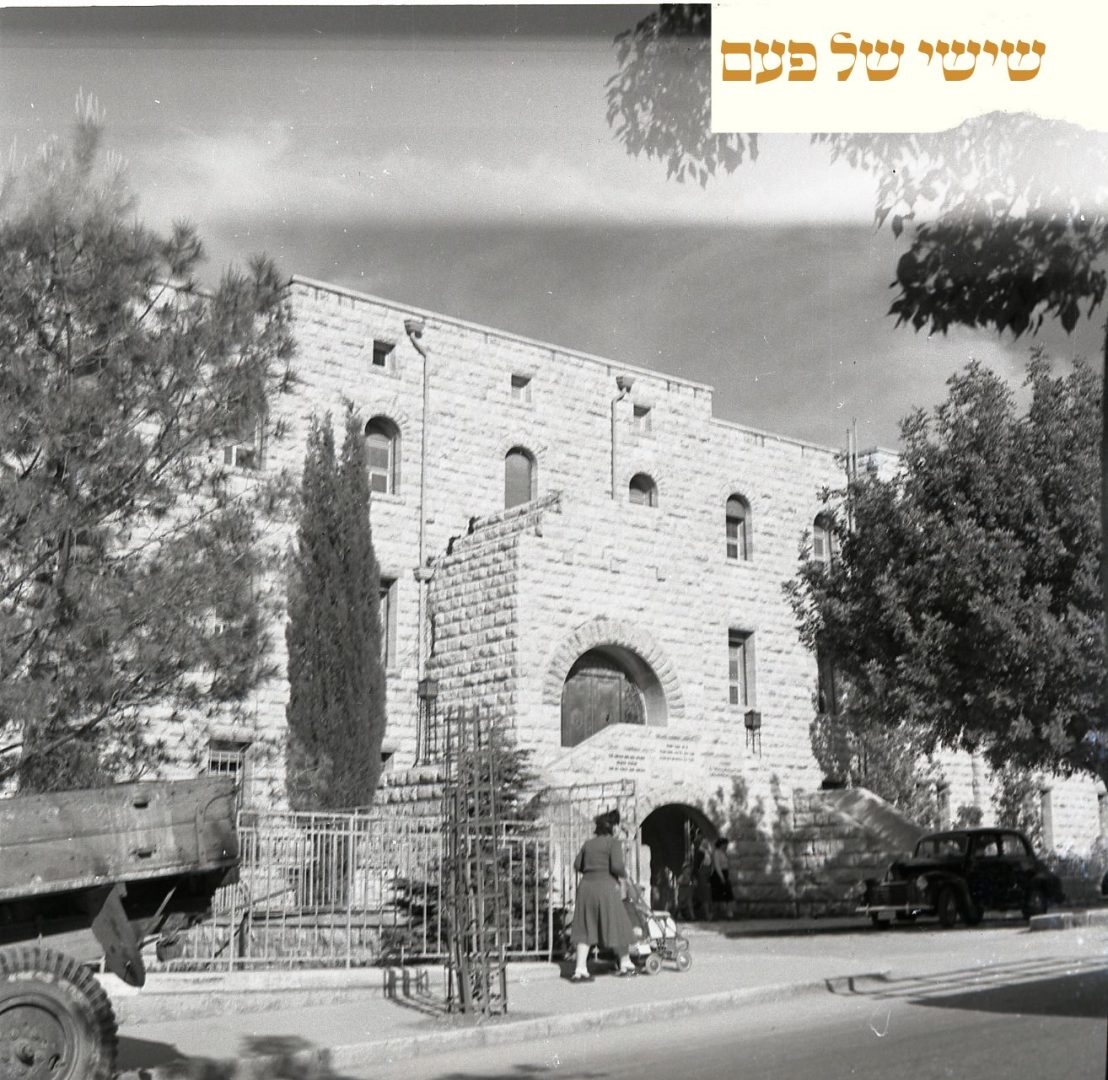
Strauss Health Centre, 1950,
Another “Once Upon a Time in Jerusalem”
At 24 Strauss Street, in the heart of one of Jerusalem’s most historic and fascinating areas, stands an impressive, monumental stone building.
Throughout the 19th and early 20th centuries, the surrounding neighborhood was home to consulates, magnificent hospitals, and grand mansions. Yet behind the gates of this particular building, a quiet revolution took place one that saved the lives of tens of thousands of the city’s children.
The year is 1927.
Jerusalem, under the British Mandate, is struggling with poor sanitation, widespread poverty, and devastating epidemics that have claimed countless lives, particularly among infants and young children.
Infant mortality in the city has reached alarming levels, largely due to infections and the consumption of unpasteurized local cow’s milk. Transported in open containers, the milk often carries dangerous diseases, including tuberculosis and intestinal infections.
Into this public health crisis steps Nathan Straus, a wealthy American Jewish businessman and co-owner of the Macy’s department store chain, who devoted much of his fortune and energy to philanthropy in the Land of Israel. The city of Netanya was also named in his honor.
Straus, who had personally experienced the loss of children and had worked extensively to promote milk pasteurization in the United States, decided to establish a pioneering center for preventive medicine in Jerusalem.
His vision was to create a medical institution that would serve all the city’s residents, regardless of religion, race, or nationality.
The initiative was undertaken in cooperation with Henrietta Szold and Hadassah, the Women’s Zionist Organization of America.
Straus entrusted the building’s design to the renowned British Jewish architect Benjamin Chaikin, one of the leading architects of Jerusalem during the British Mandate.
Among the notable buildings associated with Chaikin are the amphitheater at the Hebrew University on Mount Scopus, the King David Hotel, and Emmanuel House.
Chaikin combined traditional Jerusalem stone with the principles of modern, functional architecture.
The building featured an impressive symmetrical façade, wide windows designed to admit natural sunlight, and spacious corridors with high ceilings to ensure the circulation of fresh air – all elements considered essential in the fight against infections and bacteria.
Above the entrance gate, an inscription was carved into the stone:
“Nathan and Lina Straus Health Centre.”
When the center officially opened in 1929 under Hadassah’s management, it quickly became a groundbreaking institution.
The building housed Jerusalem’s first modern milk distribution station, supplying clean, pasteurized, carefully monitored milk in sterilized glass bottles.
The milk was sold at cost price or distributed free of charge to families who could not afford it.
On Friday mornings, even before preparations for Shabbat had begun, long queues of mothers stretched along the nearby Street of the Prophets – Rehov HaNevi’im.
Ultra-Orthodox women from the neighboring Mea Shearim district stood alongside Arab women from the Old City and pioneering Jewish women from central Jerusalem.
Baby carriages crowded the courtyard, while the sharp smell of disinfectant and iodine mingled with the aroma of fresh milk.
The building also housed a pioneering dental clinic for schoolchildren, an eye examination center dedicated to combating trachoma – a disease that had blinded many of Jerusalem’s residents and a nutrition kitchen that provided hot, nourishing meals to hungry children.
From a Centre of Healing to a Frontline Defense Post
With the outbreak of Israel’s War of Independence in 1948, Strauss Street, named in honor of Nathan Straus, became one of the city’s most tense and dangerous frontlines.
The solidly constructed Strauss Health Centre, overlooking the passage between the city center and eastern Jerusalem, served as a forward military position and a critical defensive post for soldiers of the Etzioni Brigade.
They faced Jordanian Arab Legion forces and snipers firing from the walls of the Old City.
Under a barrage of shells and sniper fire, the medical staff continued working in the building’s stone basement, providing first aid to the wounded and distributing food supplies to Jerusalem’s besieged infants.
The windows were protected with sandbags, while the building’s thick stone walls sheltered civilians and soldiers alike.
Following the war and the division of Jerusalem, the building stood just a few dozen meters from the armistice line and the Jordanian border.
Yet it continued operating without interruption as a municipal health center.
Over the years, responsibility for the building passed to the Ministry of Health and the health funds. It continued serving the public as a dental health facility and a Tipat Halavmother-and-child health center, caring for generations of Jerusalem’s children.
A Historic Landmark in a Changing Jerusalem
Today, Strauss Street and the neighboring Street of the Prophets are experiencing an extraordinary wave of renewal and development.
Historic hospitals and grand stone mansions have been transformed into prestigious residential developments and luxurious homes.
Yet the Strauss Health Centre continues to stand proudly as a historic landmark, its stones telling the story of Jerusalem in the early decades of the 20th century.
It is a story of vision, compassion, and public health, and of the challenges faced by the people who lived in Jerusalem less than a century ago.
In Jerusalem, buildings and real estate are measured not only by the quality of their construction but also by the historical stories upon which their foundations were laid.
The connection between exploring the city’s architectural heritage and a deep love for Jerusalem, developed over decades of professional experience, reminds us time and again that every stone in this city carries a soul, a memory, and an entire lifetime.
The young mothers of the 1920s are no longer with us.
The milk containers of the British Mandate era have long fallen silent.
The gunfire from the walls of the Old City faded many years ago.
Yet the spirit of generosity, saving lives, and human solidarity remains deeply embedded within the stones of the Strauss Health Centre.
This is our Jerusalem.
Epidemics come and go. Empires rise and fall.
But the Jewish people endure, continue to grow, build, renew, and create new life alongside the ancient stones.
Shabbat Shalom to those far and near from Jerusalem.
Photograph: Beno Rothenberg Archive