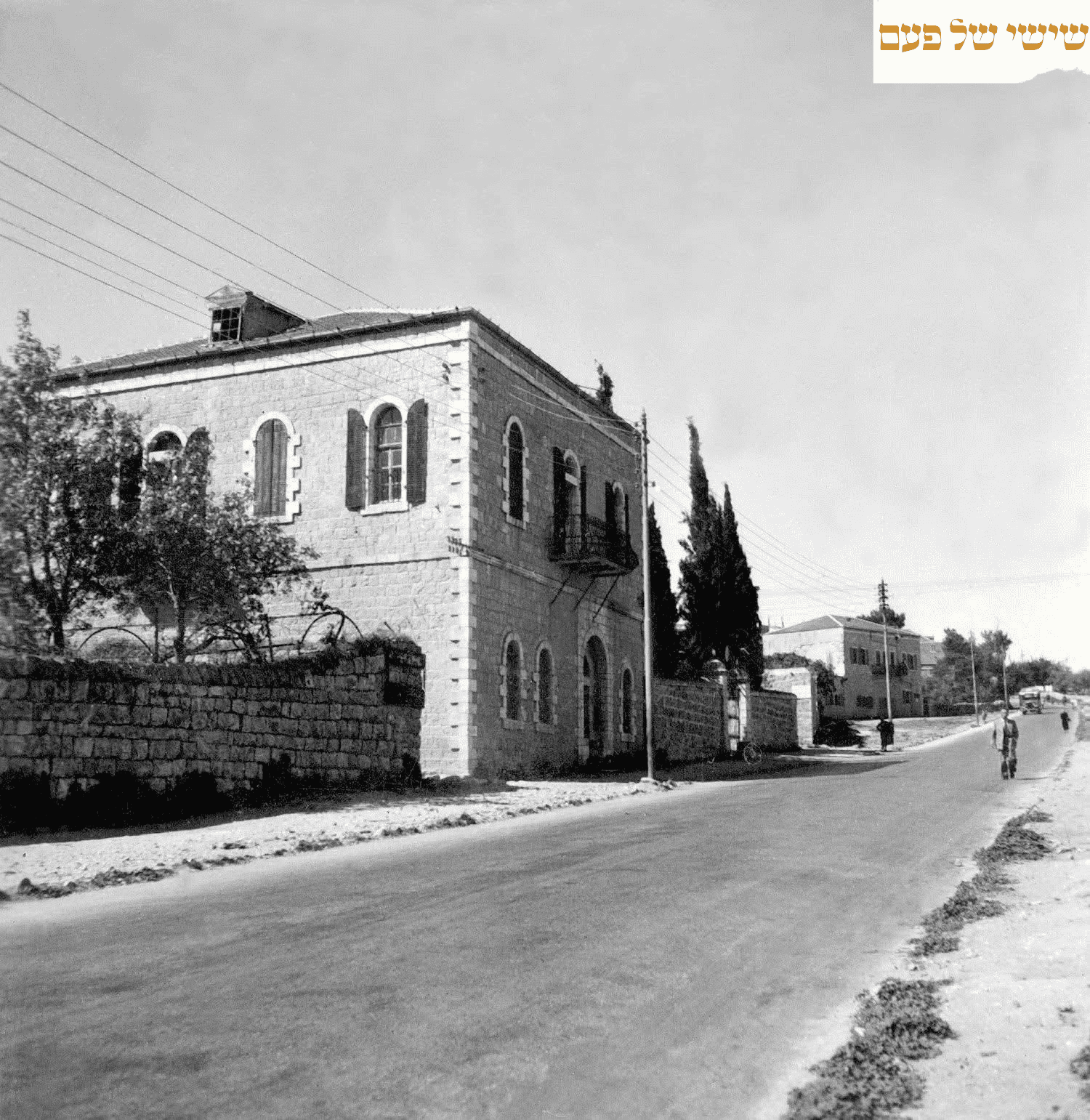
The American Consulate Building on Agron Street, 1936.
Another “Once Upon a Time in Jerusalem”
The American Consulate was located until a few years ago at 18 Agron Street, in the Wester House, built by Ferdinand Wester—a wealthy and successful German merchant who constructed his private home in 1868. It was one of the first houses built outside the walls of the Old City.
The home was considered luxurious for its time, befitting someone of wealth and status, and is still regarded today as a grand and elegant residence.
The first American consular representation was established in 1844, initially located near Jaffa Gate inside the walls of the Old City.
The first consul was Warder Cresson, an Evangelical Christian who believed that the redemption of the world would come through the return of Jews to Zion. His appointment was later revoked by the United States, but Cresson converted to Judaism, married a Jewish woman, and dedicated the rest of his life to supporting the welfare of Jerusalem’s Jewish community.
Other American consuls came and went with time. Toward the end of the 19th century, as the city expanded beyond its walls, the consulate moved to a new building at 48 Hane’viim Street, right near the corner of Monbaz Street—in the building that today houses the Yemeni Consulate for Falafel, Hilbeh (fenugreek spread), and oven-roasted Pita, as well as the Jerusalem Consulate for Bourekas Affairs.
In 1912, the consulate moved again—this time to the Wester House on today’s Agron Street.
During Israel’s War of Independence, the U.S. Consul at the time, Thomas Wasson, served on the UN Security Council’s truce committee.
Only a few weeks into his post, as he was leaving a meeting at the French consulate near the King David Hotel and returning to the consulate residence, he was shot by an Arab sniper at the corner of today’s Hess and King David streets. He died on the spot.
After the Six-Day War, the United States refrained from recognizing the unification of Jerusalem.
The Agron Street consulate functioned as the residence of the Consul General, while the consular department operated in East Jerusalem, in the building on Nablus Road.
Due to security concerns, the consulate was later relocated from Nablus Road to a section of the Diplomat Hotel in the Arnona neighborhood. The U.S. government purchased land nearby for construction, but opposition from local residents delayed the completion of the new building.
It wasn’t until December 6, 2017, that President Trump, during his first term, officially recognized Jerusalem as Israel’s capital—fashionably late by 69 years. In May 2018, the official ceremony was held marking the move of the U.S. Embassy to Jerusalem, and the Agron Street consulate building became part of the new U.S. Embassy.
To date, over 50 American consuls have served in Jerusalem—and counting.
This is our Jerusalem—a city where every stone tells a story:
From an American consul near Damascus Gate in the 19th century who converted and married a Jewish woman; to a new consulate on Nablus Street; to its relocation into the grand home of a German merchant expelled along with the Templers; to a consulate in East Jerusalem that eventually moved to the west; to the very late American recognition of Jerusalem as Israel’s capital; and finally, to the new consulate in Arnona, with embassy staff returning to the historic Wester House.
All in a city that never rests and carries the perspective of 3,000 years of history.
The new embassy may never have underground parking for stealth B-2 bombers, but the special bond between Israel and the United States—its ally in the jungle that is the Middle East—will likely continue for many years to come.
Shabbat Shalom to all, far and near, from the Eternal City of the Jewish people.
In memory of the IDF soldiers who fell this week defending the nation,
For the speedy return of our kidnapped brothers,
In honour of our pilots and intelligence personnel,
And may we merit true unity among ourselves.
Photographer unknown