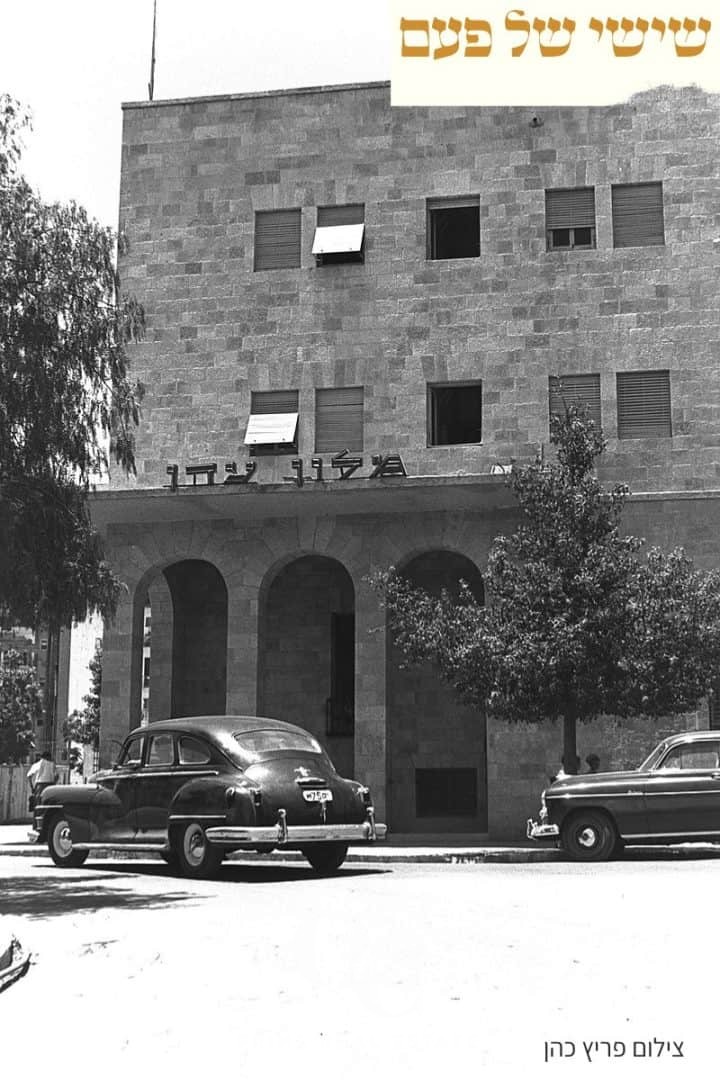
Another Once Upon a Time in Jerusalem – and this time, the Eden Hotel on Hillel Street, 1950.
The Eden Hotel was founded by Rosa and Avraham Lipshitz, designed by architect Yohanan Ratner, and opened to the public on April 10, 1938, during the British Mandate. It was located on what is now Hillel Street, at the corner of Histadrut Street.
An article published in the newspaper Haboker on April 12, 1938 described the occasion as “the opening ceremony of the magnificent Jewish hotel in Hebrew Jerusalem.” Among those in attendance were Yitzhak Ben-Zvi, Deputy Mayor Oster, Judge Valero, Henrietta Szold, members of the Jewish National Council, and representatives of the Jerusalem City Council.
The journalist, clearly impressed by the building, wrote:
“The magnificent building, which cost over 11,000 Palestine pounds, includes a spacious and elegantly furnished lobby leading to two large and luxurious dining halls that can be combined into one, making them suitable for banquets, celebrations, and public gatherings. Every room is equipped with a telephone and electric call bells using illuminated signaling, and most rooms include private bathrooms.”
The hotel was designed in the International Style, heavily influenced by the German Bauhaus movement while incorporating local architectural elements – arched façades, a flat roof, rectangular windows, and balconies, representing the height of elegance and luxury at the time.
The entrance to the 40-room hotel was located on Hillel Street, with three grand arches facing Histadrut Street and a distinctive entrance canopy inspired by Bauhaus architecture.
Its elevated location, where Hillel Street slopes steeply toward Mamilla and the Old City, offered guests breathtaking views of Jerusalem’s ancient walls.
Thanks to its proximity to the Jewish National Institutions building at the end of Keren Kayemet Street, the hotel became the premier meeting place for Zionist leaders of the growing Jewish community in the Land of Israel.
It hosted meetings with journalists from Israel and abroad, interviews with the young Jewish conductor Leonard Bernstein on the hotel’s terrace overlooking the Old City, and countless conversations with the leading figures of the Jewish community of that era.
Following the establishment of the State of Israel, the hotel also benefited from its close proximity to Beit Frumin, the original home of the Knesset. Members of Knesset from outside Jerusalem, journalists, and many of the young state’s distinguished guests regularly stayed at the elegant yet intimate hotel.
Prime Minister David Ben-Gurion himself lived at the hotel continuously for a year and a half, just a short walk from the old Knesset building. His presence attracted crowds of Jerusalem children, who would gather outside hoping to receive his autograph, long before the era of selfies and celebrity culture, and catch a glimpse of the many prominent figures who frequented the hotel.
In late August 1966, when the Sixth Knesset moved to its new home in Givat Ram, the hotel’s prominence gradually faded.
By the mid-1970s, the hotel had been sold to the Bank of Israel, which used the building for its offices. It later housed the Ministry of Immigrant Absorption.
In 1997, the building was sold to private developers. From that point onward, it stood vacant for many years, its former glory slowly fading into memory.
As part of Jerusalem’s urban renewal and the remarkable transformation the city has undergone in recent years, the magnificent hotel is now coming back to life.
The iconic building is being restored and transformed into an exclusive residential development – the first flagship Jerusalem project by developer Yossi Avrahami. New floors with balconies overlooking the ancient panorama of the Old City are being added, while a dramatic open-air central atrium will welcome future residents.
The historic hotel rooms, once equipped with telephones and illuminated call bells, are being replaced by luxurious modern residences featuring spacious balconies, alongside an indoor swimming pool, fitness center, and wellness facilities. The historic façade will be carefully preserved, blending timeless elegance with contemporary luxury.
It is truly inspiring to witness buildings whose walls are steeped in the history of the renewal of the Jewish-Zionist settlement in the Land of Israel being brought back to life before our eyes in the heart of this extraordinary city.
On a personal note, I am deeply grateful for the privilege of accompanying the building’s revival over the past several years, of being entrusted with its future residents, and of ensuring that those who will call it home, from Israel and abroad, will come to appreciate the building’s remarkable history, so deeply intertwined with the rebirth of the Jewish people in their homeland, and recognize the soul and heritage preserved within its historic walls.
Even after 3,000 years, Jerusalem continues to live, breathe, and evolve.
Wishing a Shabbat Shalom to those far and near, from Jerusalem. ❤️
Photo: Fritz Cohen.