Another “Once Upon a Time in Jerusalem”
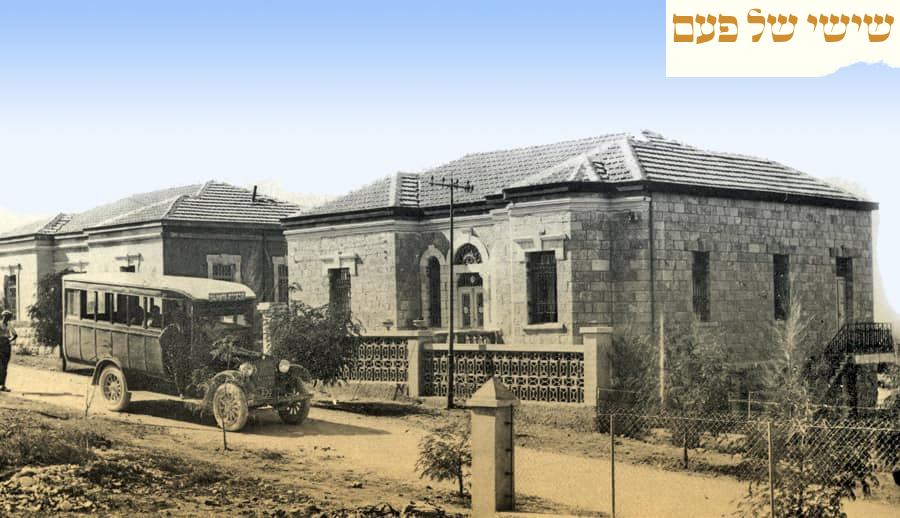
And this time – the first bus in the Talpiot neighborhood, 1925.
In 1911, Yitzhak Levy, director of the Anglo-Palestine Bank (the main financial institution of the Jewish community under Ottoman rule), approached Arthur Ruppin, head of the Palestine Office of the World Zionist Organization, requesting to build a residential neighborhood in Jerusalem for the bank’s employees.
After an extended search, a 145-dunam plot of land was found in southern Jerusalem, previously owned by the German Templer community.
The Templers refused to sell only part of the land for the housing project, so Ruppin decided to buy the entire plot with the ambitious vision of building a modern Jewish city next to the Old City, with plans for 800 housing units.
Under Ottoman rule, city planning and construction were largely unregulated.
Planning began—but World War I disrupted everything.
After the British conquest of Palestine, the planners had to submit a neighborhood master plan to the new authorities.
In 1920, Ruppin turned to Richard Kauffmann, the renowned German-Jewish architect who had already designed neighborhoods like Rehavia, Beit HaKerem, the town of Nahalal, the city of Ramat Gan, and more.
After months of work, Kauffmann presented a detailed plan for Talpiot, based on the “garden city” model—green, spacious neighborhoods where green areas exceed the built areas, featuring a central tree-lined boulevard and public gardens.
Kauffmann even received a rare permit from the British to use plaster-coated buildings in part of the neighborhood—despite British orders that all Jerusalem homes be faced with local stone, a requirement that remains in force to this day.
The plan included: A hotel, an immigrant absorption center, a public bathhouse, a sports field, a synagogue, Kindergartens and an art academy.
Public buildings were arranged around the hilltop where Talpiot was located.
The art academy was planned for the very top, with most of the neighborhood offering views of both the Old City walls to the west and the Dead Sea and Edom Mountains to the east.
The name “Talpiot” was inspired by the view and the verse from Song of Songs:
“Your neck is like the tower of David, built for Talpiot…”
Street names were given based on the settlements and landscapes visible from the neighborhood, such as Kfar Etzion and Beit HaArava, or landmarks like Dead Sea Street, Jordan Street, Gilead, Ein Gedi, and more.
Talpiot was considered remote and detached from central Jerusalem (centered on Jaffa Street and the Russian Compound), making it a true peripheral suburb.
Construction progressed rapidly, and by 1924, forty houses had been built.
Notable early residents included: Eliezer Ben-Yehuda, Aryeh Leib Yaffe, head of the Jewish National Fund, Artist Abel Pann, and Literature professor Yosef Klausner.
Residents didn’t even pay taxes to the Jerusalem municipality—the local neighborhood committee handled water, electricity, and even public transportation.
The photo shows the first bus in Talpiot, 1925.
The great writer S.Y. Agnon, one of the neighborhood’s first residents and a Nobel laureate, wrote in his book “The Fire and the Wood”:
“There was a bus that came and went four times a day, but what if one needed to consult with a neighbor? There were no telephones. So he would take a shofar, climb to his rooftop, and blow. The neighbors heard and came.”
And thus, the neighborhood’s first startup was born:
A public announcement system and smart travel app, powered by a ram’s horn—completely wireless and never needs charging.
Later, construction stalled due to internal ideological conflicts within the “Gdud HaAvoda” (Labor Battalion), which eventually disbanded in 1927.
It was yet another painful reminder of the age-old Jewish infighting—
from Joseph and his brothers, the Golden Calf, the spies, the destruction of the Temples, Masada (partial list),
to the internal battles during the British Mandate era… and sadly, even today.
Apparently, after all this time—we’ve still learned nothing.
A bloody reminder of this reality struck us again on Simchat Torah almost 2 years ago.
Will we learn anything from 3,000 years of Jewish conflict?
Only time will tell.
(Sad spoiler: Based on past experience, the outlook isn’t great.)
In the end, less than 10% of Kauffmann’s grand garden city vision was realized.
After Israel’s War of Independence, Talpiot became a border neighborhood, with its eastern edge forming Jerusalem’s easternmost boundary.
The northern part of Beitar Street bordered the demilitarized zone with Jordan, patrolled by UN forces until it was liberated in the Six-Day War.
After that war, the border moved to the Jordan River, and Talpiot underwent a transformation.
The charming rural homes were demolished to make way for 3- to 4-story apartment blocks—
ugly, utilitarian buildings, some of which are now being torn down in urban renewal projects, replaced by towering high-rises along Derech Beit Lehem.
And thus passes the glory of the world.
May our kidnapped brothers return quickly to their homes, along with the IDF soldiers. May we finally learn from our painful, bloody past and merit to populate Jerusalem with the homes and people it truly deserves.
Shabbat Shalom to all those far and near and may we hear good news from Jerusalem ❤️
Photo edited by Tamar Hayardeni – photographer unknown.