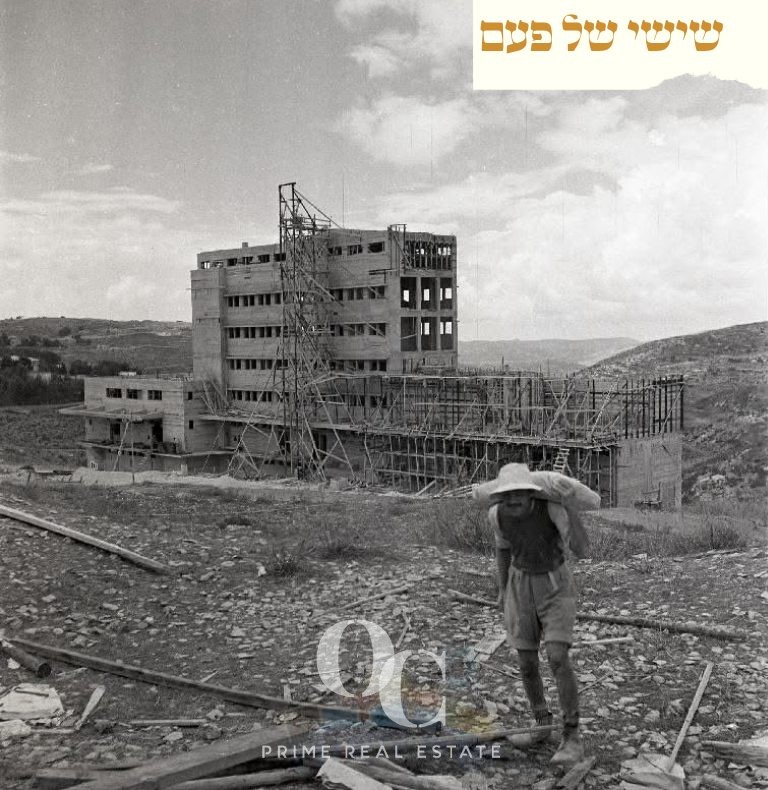
Another Once Upon a Time in Jerusalem – and this time, the flour mill in Givat Shaul.
Jerusalem’s flour mill was built in 1950 at the corner of Farbstein Street and what is today Beit HaDefus Street, on the border between the neighborhoods of Givat Shaul and Kiryat Moshe.
The mill was built during the first years following the establishment of the State of Israel, when memories of the siege of Jerusalem were still deeply etched in the minds of the city’s residents and the young nation.
A facility was established there to store large quantities of flour for what was then a small city, and it served as a secret reserve of flour and grain for Jerusalem’s residents.
It was the city’s only flour mill.
The well-known Jerusalem-based Angel Bakery began its journey in 1927 in a small bakery in Beit Vegan. After the flour mill and its wheat reserves were established, the bakery decided to relocate nearby, moving to its new bakery in Givat Shaul in 1958.
Every morning, the aroma of freshly baked bread drifted through the air, perhaps the most irresistible scent for awakening the appetite, spreading throughout the nearby Kiryat Moshe neighborhood.
I still remember my childhood days, when the sun would begin to rise after Selichot prayers at the synagogue of my late grandfather, Shlomo, in Kiryat Moshe. I would leave the synagogue at dawn and follow the aroma as though under a spell, or, more accurately, a spell cast by the scent of fresh bread. Alongside me were taxi drivers, a colorful assortment of delivery trucks setting out across the country, and simply hungry people who could not resist the temptation.
I was eight or nine years old when, for the first time, I bought a loaf of bread straight from the oven to bring home to my mother. But the smell of the bread, combined with my morning hunger, meant that by the time I arrived home, all that remained in the bag was one last piece and a scattering of crumbs, evidence that there had once been an entire loaf inside.
The next time, I had learned from experience and bought two loaves from the start. Those were the days when carbohydrates and bread were still considered perfectly legitimate foods, enjoyed without guilt – years before the age of lentil sprouts, kale leaves, tofu, and seaweed.
Residents of nearby Kiryat Moshe frequently complained about the smell and flour dust drifting through the air from the mill, as well as the breathing difficulties it caused. Before Passover, some of the more stringent residents would even leave their apartments for the week, worried that traces of wheat flour might float in on the western breeze and land on their plates or balconies – because, as the saying goes, “If there is no flour, there is no Torah.”
The flour mill closed in 2015.
In August 2021, the historic mill was demolished in a ceremony attended by the mayor. In its place, an innovative new development is now being built, combining residential apartments, offices, a hotel, and commercial spaces.
And so passes the glory of the world…
A flour mill from the early days of the State, built to stockpile flour and grain against the possibility of another siege and difficult times; a facility that became Jerusalem’s sole center for flour production; a Jerusalem bakery that grew alongside it and drew early risers who followed the irresistible aroma of freshly baked bread and challah; and now, a modern development that will include two enormous towers, commercial areas, and offices – in a city that never stands still.
Shabbat Shalom to those far and near, from Jerusalem.
Photo: Werner Braun Photo Collection.