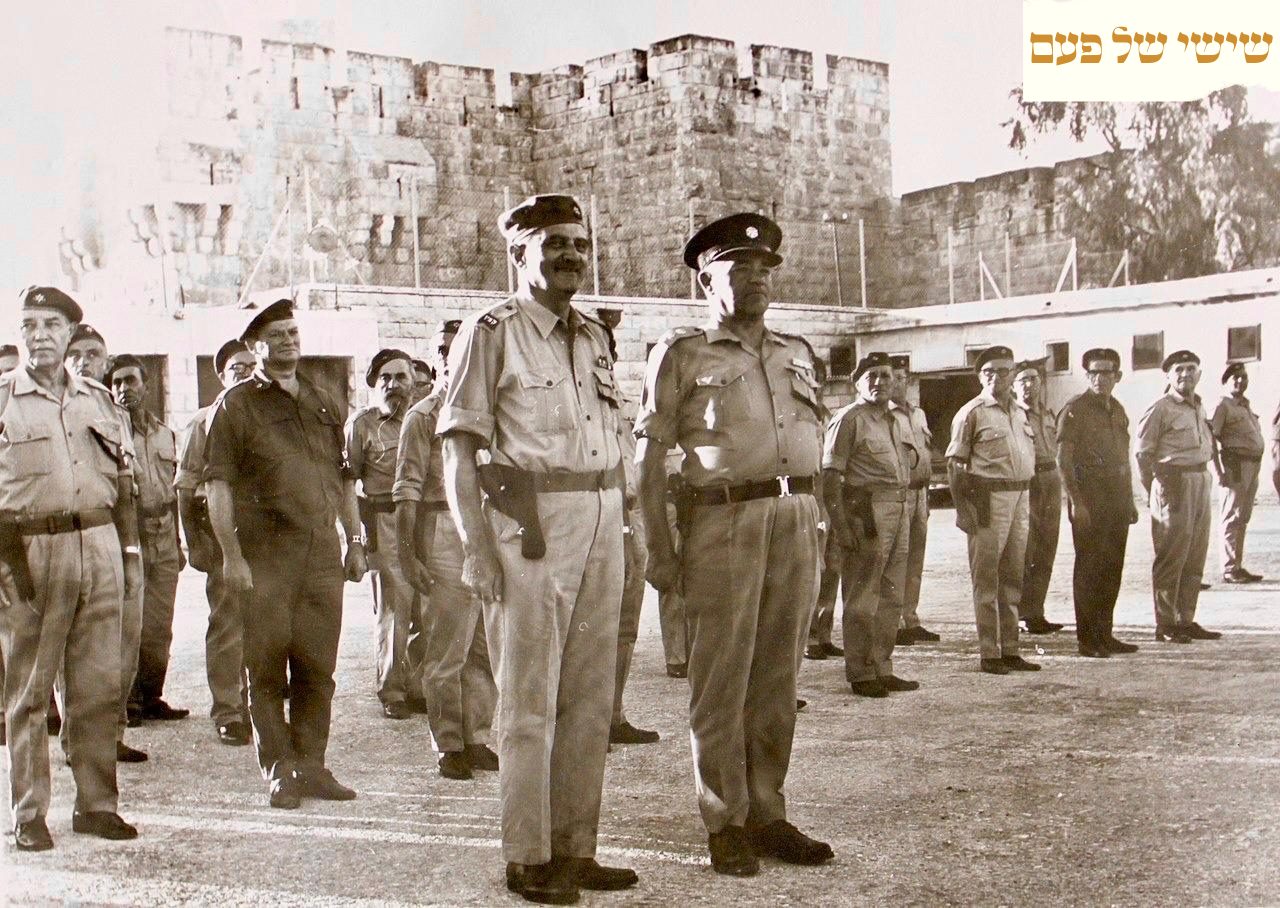
The Kishle Station in the Old City, the opening ceremony of the police station, July 1967.
Another Once Upon a Time in Jerusalem
The Kishle compound is located within the Old City walls of Jerusalem, near Jaffa Gate and adjacent to the Tower of David.
The building was constructed in 1833 as the summer palace of Muhammad Ali, ruler of Egypt, and his son Ibrahim Pasha.
At the time, Muhammad Ali and Egypt rebelled against the Ottoman Empire in Istanbul. As a result, they built a fortified and well-guarded summer palace inside the walls: its northern side facing the moat that once surrounded the Tower of David, and its western side pressed against the city wall itself, meant to shield them from the Ottoman’s revenge and ensure their personal security.
The structure is shaped as a large square surrounding an open courtyard, with a very tall ground floor designed to enclose and protect the compound and its residents.
Rulers and rebels rise and fall, as history has shown time and again, and after Muhammad Ali’s regime was toppled by the Ottoman army, the compound was repurposed as housing for the Turkish soldiers who guarded the Old City.
Urban legends claim that during demonstrations or civil disturbances, the Turkish policemen would shout “Kishle!”, understood to mean, “If you don’t disperse, we’ll drag you by force to the Kishle!”
From this, the cry was distorted over time and became “Kishta,” the Jerusalem slang for “go away,” said to anything frightening or unwelcome that suddenly appears, and naturally, to curious female cats, since in Jerusalem slang there are no male cats at all.
After the British Mandate forces captured Jerusalem, the Kishle became the central parade ground of the Mandate in the Old City and a military base for British soldiers.
With the establishment of the Mandatory Police in 1921, the Kishle became the British police station of the Old City.
Over the years, the Kishle turned into a prison and detention center for members of the Jewish underground movements. Twenty fighters were imprisoned there after defending the Jewish community from Arab rioters during the 1920 disturbances. Among those held in the compound was Ze’ev Jabotinsky.
Jerusalem, as we know, never rests. After the British were expelled and the Old City was captured by the Arab Legion in Israel’s War of Independence, the Jewish fighters who defended the residents of the Jewish Quarter were taken prisoner in the Kishle before being transferred to a POW camp in Jordan.
After the liberation and reunification of Jerusalem in the Six-Day War, the Kishle became the Israeli police station responsible for the Old City.
In the photo: tough, stern-looking policemen, something like a Jerusalem version of Officer Azoulay, at the opening ceremony of the police station in the Kishle after the reunification of the city, on July 31, 1967.
This is our Jerusalem: a city constantly renewing itself, a city that has seen everything, and yet reality keeps surprising both it and us, again and again.
A rebellious Egyptian governor under Ottoman rule who wanted a fortified vacation palace in the Old City, which later became an Ottoman police station, then was taken by the British and used as a detention center and drill ground where they failed to protect a Jewish population that suffered severely from Arab rioters who maintained a consistent appetite for bloodshed.
A leader of the Beitar movement imprisoned there, followed by Jordanian control, until the place was redeemed in the Six-Day War and went on to house Arab offenders and homegrown Israeli criminals alike.
Truly a local point of pride.
A Jerusalem “Chad Gadya,” in a city where every stone tells a story without end.
Wishing a peaceful Sabbath to those far and near from Jerusalem.
Photographer unknown.