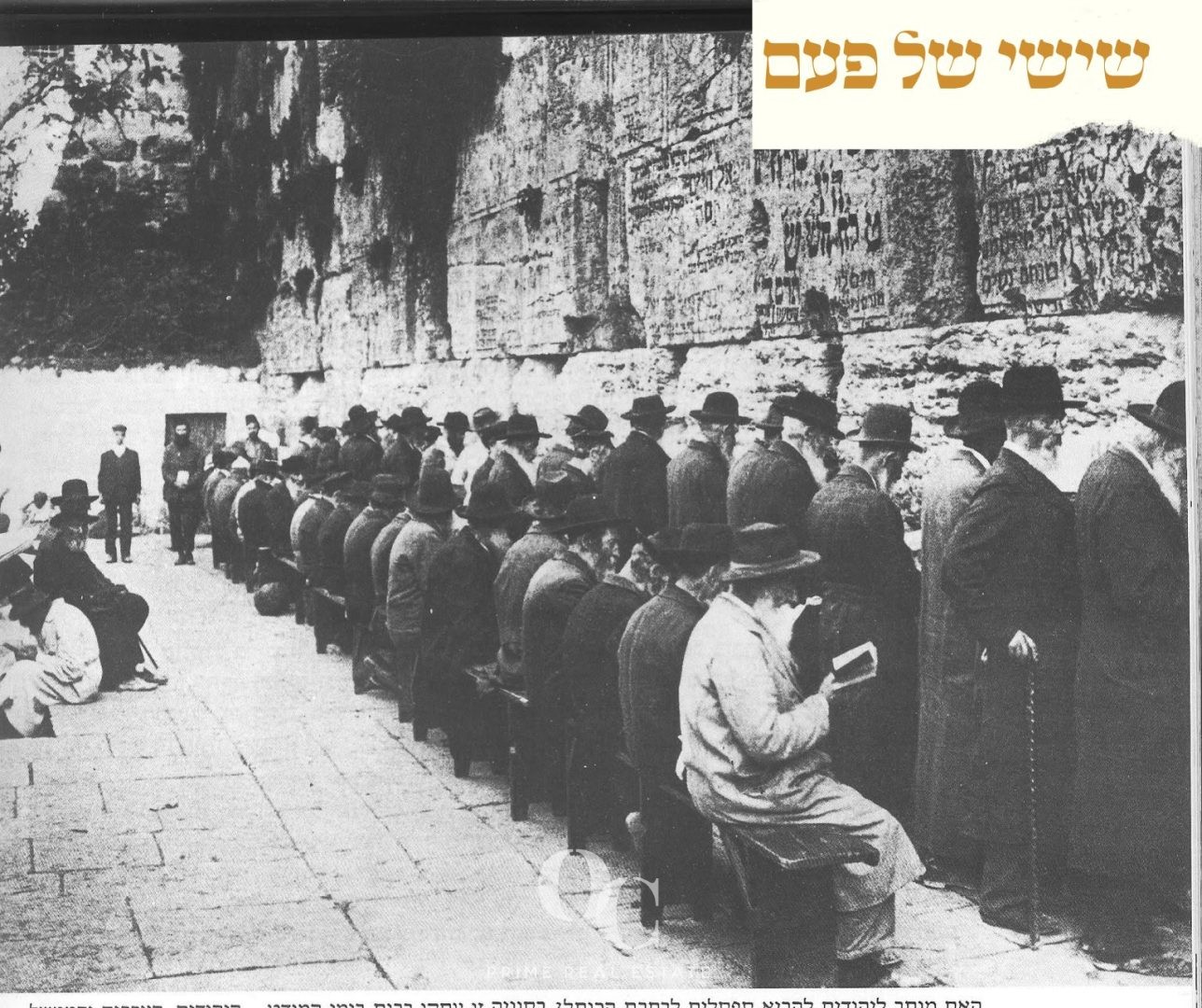
Another Once Upton a Time in Jerusalem – and this time, The Western Wall Plaza, Tisha B’Av 1929.
Tisha B’Av is the Jewish day of mourning for the destruction of Jerusalem and the Holy Temple, understood to have occurred because of baseless hatred (sinat chinam).
Tisha B’Av marks the end of the Three Weeks, which begin on the 17th of Tammuz-the day the walls of Jerusalem were breached before the destruction of the Second Temple. On the 9th of Av, both the First and Second Temples were destroyed, set ablaze, and continued burning until the 10th of Av.
Many other tragic events throughout Jewish history are also associated with Tisha B’Av: the expulsion of the Jews from England in 1290 by King Edward I; the expulsion of the Jews from France in 1306 under King Philip IV; the Expulsion from Spain in 1492; the outbreak of World War I and Germany’s entry into the war; the imprisonment and deportation of French Jews to concentration camps; the mass deportation from the Warsaw Ghetto to the Treblinka extermination camp; the burning of the Talmud; the massacres of 1648–1649 in Poland, Ukraine, and Russia; and the 1929 riots against the Jewish community in the Land of Israel. This is only a partial list.
These were difficult and painful times, filled with bloodshed and loss, that have become part of the Jewish people’s history across the generations in a haunting and recurring pattern.
Jewish tradition teaches that the Second Temple was destroyed because of baseless hatred, even though the people of that generation were devoted to Torah study, mitzvot, and acts of kindness.
Baseless hatred is one of the most destructive traits in human nature. It is hatred without legitimate cause-when a person hates another individual or group simply because they think differently or belong to a different community. Each side becomes convinced that it alone possesses the truth.
During the Roman siege of Jerusalem, three Jewish factions fought one another from within the city walls instead of uniting against their common enemy. Their internal conflict weakened them, allowing the Romans to conquer Jerusalem, destroy the Temple, and exile the Jewish people from their city for two thousand years.
Even today, it seems we have still not fully absorbed that lesson. Our tendency toward self-destruction continues to surface, day after day.
Tisha B’Av is not merely a historical date commemorating events that took place centuries or millennia ago. It is a painful annual reminder, a wound that has never completely healed, warning us what can happen, God forbid, if we fail to learn the price of baseless hatred.
In the difficult days we are living through now, it is all too easy to recognize expressions of baseless hatred among us: in politics and the rhetoric of populist politicians who speak without restraint; on social media, where anyone can type cruel words toward others with poison at their fingertips; in jealousy and pettiness; in blind hatred; on our roads; in the growing violence against the elderly, women, the families of hostages, and ordinary people; in increasingly hostile public discourse; and in the hatred directed at fellow Jews simply because they hold different opinions.
The warning is written on the burned walls of Jerusalem in letters too large to ignore. They remind us where we, as a people and as a society, can end up if we do not replace baseless hatred with unconditional love, and if we fail to remember that we are all parts of the same body-we are all brothers and sisters.
“If we were destroyed, and the world with us, through baseless hatred, then we shall be rebuilt, and the world with us, through baseless love.” – Rabbi Kook
May we find the wisdom to put the painful lessons of our past into practice today, and may we be comforted through the rebuilding of Jerusalem.
Wishing a Shabbat Shalom to those far and near, from Jerusalem.
May we finally learn this painful lesson, understand what happens to us as a people when we repeat the same mistakes again and again, and may we increase love without conditions. ❤️
Source: Wikimedia Commons Photo Archive.