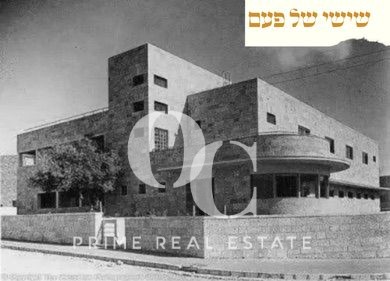
Another Once Upon a Time in Jerusalem, and this time, the Aghion House.
The Aghion House is a corner building in Jerusalem’s Talbiya neighborhood, at the intersection of Balfour and Smolenskin Streets.
The house was built for the Jewish-Greek businessman and merchant Edward Raphael Aghion, who was one of the wealthiest men in Alexandria, Egypt, at the time.
The Aghion family originated in Spain. They later migrated to Thessaloniki, Greece, and then to Alexandria, Egypt.
Aghion studied in Alexandria and Paris and became a successful businessman.
His wife, Linda, who was born in Cairo, was the first woman in Egypt to become a lawyer and also served as president of WIZO in Egypt.
Aghion founded and managed the Egyptian Cotton Exchange and became one of the country’s leading businessmen.
In 1935, Aghion immigrated to the Land of Israel with his family. He was among the founders of Migdal Insurance, and he established and invested in the Vulcan factory and the Phoenicia glassworks – industries of the small country-in-the-making, which was still under British rule.
Upon arriving in the country, Aghion purchased land in the Talbiya neighborhood and hired the services of renowned architect Richard Kauffmann, whom I have written about before. Kauffmann designed, among other things, Jerusalem’s Rechavia neighborhood and more than 100 other communities throughout the country.
Construction began in 1936 according to Kauffmann’s plans, and the original building was completed and inaugurated in 1938.
In 1947, the Aghion family was ordered to evacuate the house by the British authorities, who established a security zone around the property.
After the British were expelled from the country and during Israel’s War of Independence, Aghion allowed Irgun fighters to use the house as a hospital for those wounded in battle.
Following the outbreak of the War of Independence, and as a rather ironic “thank you” from the Egyptian authorities for Aghion’s extensive contribution to the local economy, the Egyptian government nationalized all of the family’s property and businesses.
In 1952, the State of Israel purchased the house from Aghion with the intention of using it as the official residence of then-Foreign Minister Moshe Sharett, and the Aghion family moved to Haifa.
In 1973, the building became the official residence of the Prime Minister of Israel, replacing the house on Ben Maimon Street that belonged to the Jacobs family, which I have written about previously, as well.
In June 1974, Prime Minister Yitzhak Rabin moved into the house for his first term. He was followed by Menachem Begin, who in a sense came full circle by living in the former Irgun hospital, the organization he had once commanded – then Yitzhak Shamir, Shimon Perez, and others.
Students at the music academy located near the Aghion House used to tell stories of morning encounters and handshakes with their famous neighbors.
Prime ministers would come out of the neighboring residence and meet students near the school steps – back in the old days, when guests were offered tea and cookies, before the era of security teams who look like they stepped out of The Matrix, speaking into their sleeves while wearing sunglasses and earpieces.
After Menachem Begin retired, renovation work was carried out inside the house. In the 1990s, a security wall was constructed around the residence, and part of Balfour Street was closed to traffic.
Over the years, the corner of Balfour and Ben Maimon Streets became a kind of public square, while the fence of Terra Sancta became something of a political Wailing Wall.
Prime ministers came and went, or were assassinated, but to this day, anyone who is hurting, protesting, or simply feels the need to do something and make sure the prime minister hears about it over his morning coffee comes to the fence and lays out their arguments in a passionate dialogue with the stones.
Only 87 years have passed since the house was completed, yet it seems to have witnessed enough historic events to fill at least 500 years in a slightly calmer country.
But this is our Jerusalem, where every stone tells a story and every building leaves behind a trail of history still being written.
And respect is due to Mr. Aghion, a Jew whose family originated in Spain, migrated to Thessaloniki in Greece, succeeded in commerce and moved again to Alexandria in Egypt.
He prospered there, founded the Egyptian Cotton Exchange, immigrated to the Holy Land while it was still under foreign rule, bought a home in the Land of Israel, invested in an insurance company that would become an empire and in industrial factories in a country still under British occupation, at a time when the declaration of Jewish independence seemed like science fiction.
With the establishment of the State, he lost everything he had accumulated in Egypt, and lived to see the Zionist vision become a reality.
It is the story of the Wandering Jew, thanks to whom, and to others like him, we can finally put down the wandering staff.
Shabbat Shalom to those far and near, from Jerusalem.
Photographer: Unknown