Another “Once Upon a Time in Jerusalem”,
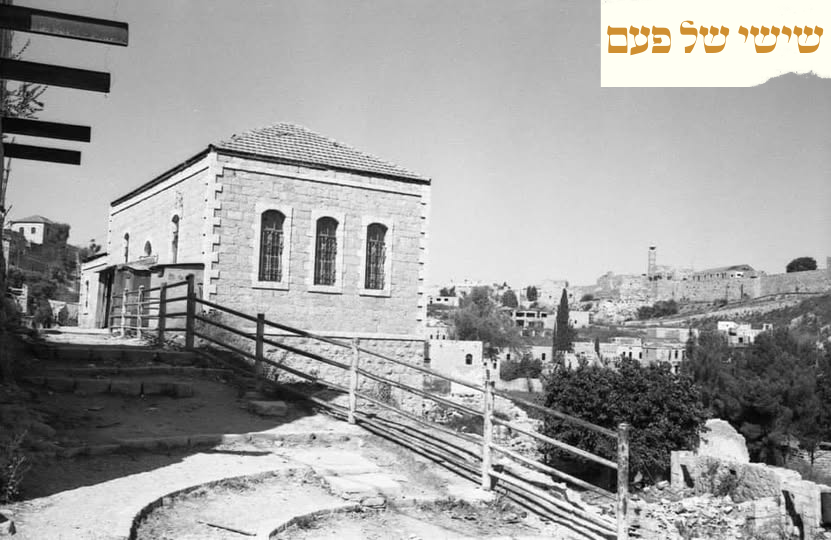
And this time, Yemin Moshe neighborhood, mid-1960s.
This neighborhood, adjacent to the Old City, was established in 1891 in response to the need to expand living spaces for the impoverished Jewish community living in overcrowded, substandard conditions in the Jewish Quarter within the Old City walls.
The neighborhood was founded by the Anglo-Jewish philanthropist Sir Moses Montefiore and was originally called Mishkenot Sha’ananim.
The demand for the first residential building (which still stands today), a long, narrow structure divided into small rooms for families leaving the Old City, was initially low. Montefiore and his associates had to persuade and incentivize the first families to move there.
To step out of the comfort zone. With the passing years, perspective comes, time rushes forward, yet human nature does not change quite so quickly…
It took strong persuasion and financial benefits to convince a few poor families- who lived in poverty in the Jewish Quarter, crammed multiple people into a single room, surrounded by Arab neighbors, with no welfare, no open land, trees, birds, or nature, and no real livelihood- to make the move.
It’s somewhat reminiscent of the Israelites after leaving Egypt. When they reached the sea, some asked Moses to return to Egypt, to the “flesh pots” and the slave mentality.
Changing a person’s mental rigidity and the so-called truths they tell themselves is sometimes as difficult as the splitting of the Red Sea.
To break out of one’s comfort zone and mental fixation requires summoning determination and the will to push past the imaginary boundary that exists only in our limited consciousness.
Each of us, in our own comfort zone that no longer serves us, should take inspiration from Nachshon ben Aminadav, who was the first to leap into the Red Sea. The moment he entered, the waters parted, and he, and the entire nation crossed to freedom.
Faith and trust.
Decades later, at the start of the War of Independence Yemin Moshe was abonded. After the establishment of the state, it was populated by new immigrants, mainly from Turkey and Kurdistan.
Following the Six-Day War, the neighborhood was controversially designated by the government as a neighborhood for artists, academics, and writers. The new immigrants who had resettled and revived the area after its abandonment were forcibly removed, and in their place came artists from various fields, writers, and intellectuals.
Over the past two decades, there has been a slow yet steady shift: the writers, thinkers, and artists who once defined the neighborhood have gradually given way to a different kind of presence Jewish financiers and entrepreneurs from around the world.
Drawn by the breathtaking landscape, with its sweeping views of the Old City walls and the Tower of David, and guided by a mix of Zionist spirit and love of the land, they have turned the neighborhood into their home.
A comfort zone and fixed ways of thinking, set against history as it unfolds. Wealth and elite circles, side by side with independent new immigrants. The old and the new in constant entanglement.
This is Jerusalem.
Shabbat Shalom from Jerusalem, to friends far and near.
May our kidnapped brothers and sister return home soon, along with all IDF soldiers. May we merit true unity among ourselves, and may peace come to Israel.
Photo courtesy of the Yitzhak Saad z”l photo collection