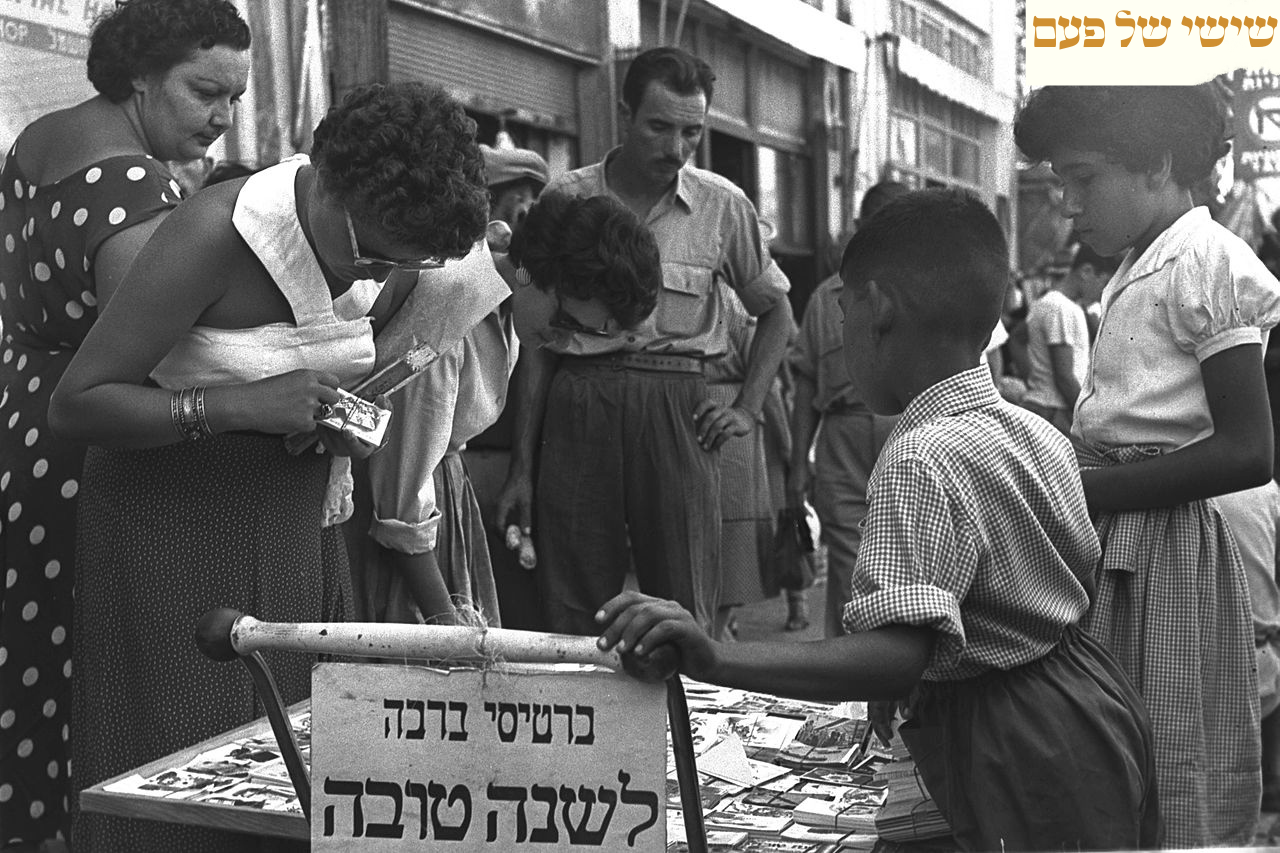
A Stand for Selling New Year’s Postcards, 1955,
another “Once Upon a Time in Jerusalem”
Rosh Hashanah has always been a time to send blessings to family and the global Jewish community, both near and far, by writing and sending New Year’s greetings, often in the form of postcards or illustrated letters.
This tradition dates back to the Middle Ages, when people would begin crafting their greetings weeks in advance to make sure they arrived in distant communities in time for the holiday.
With the invention of postal cards in the late 19th century, the custom became more widespread and accessible.
Jewish communities around the world embraced it, sending “Shanah Tovah” cards as part of the holiday tradition, and as a way to stay connected with Jewish life and heritage, especially with the growing Yishuv in the Land of Israel.
In the early Jewish community in pre-state Israel, the custom evolved to include postcards decorated with scenes from the Holy Land; illustrations of biblical events, revered rabbis, the Western Wall, and shivat haminim – often sent to donors and supporters abroad, both as New Year’s greetings and as a form of outreach for support.
During World War I, New Year postcards depicted Jewish soldiers on the battlefield. In World War II, Rosh Hashanah cards were created in ghettos with Yiddish rhymes, including a remarkable album of 32 postcards discovered among the ruins of the Warsaw Ghetto after its liberation by Allied forces.
In the 1940s and 1950s in Israel, New Year’s postcard stands became a familiar sight, on the main streets before the Chag. These cards were now industrially printed and featured images of the Land of Israel, shofars, peace doves with olive branches, and idealized visions of peace and spirituality.
That same dove, by the way, the one with the olive branch, is still flying around. It seems she hasn’t yet found a quiet place to land, or perhaps got caught in a net along the way, or simply turned back after finding nowhere to park.
With the arrival of the telephone, the practice began to fade. And with the rise of mobile phones, the tradition of sending physical “Shanah Tovah” cards nearly disappeared entirely, replaced by generic, mass-distributed text messages sent with a tap of the finger to every contact in the phone, including the kid’s, who’s now in the army, old kindergarten teacher, and “Menashe the plumber – do not answer.”
Wishing a happy new year and Shabbat Shalom to those far and near from Jerusalem.
May our kidnapped brothers and sister return home soon, along with the IDF soldiers, may we merit true unity among ourselves and may peace come to Israel.
May this year and its curses end, and may we all be renewed in a year that is good, sweet, peaceful, and blessed.
Photo by Moshe Friedman – The National Photo Collection.