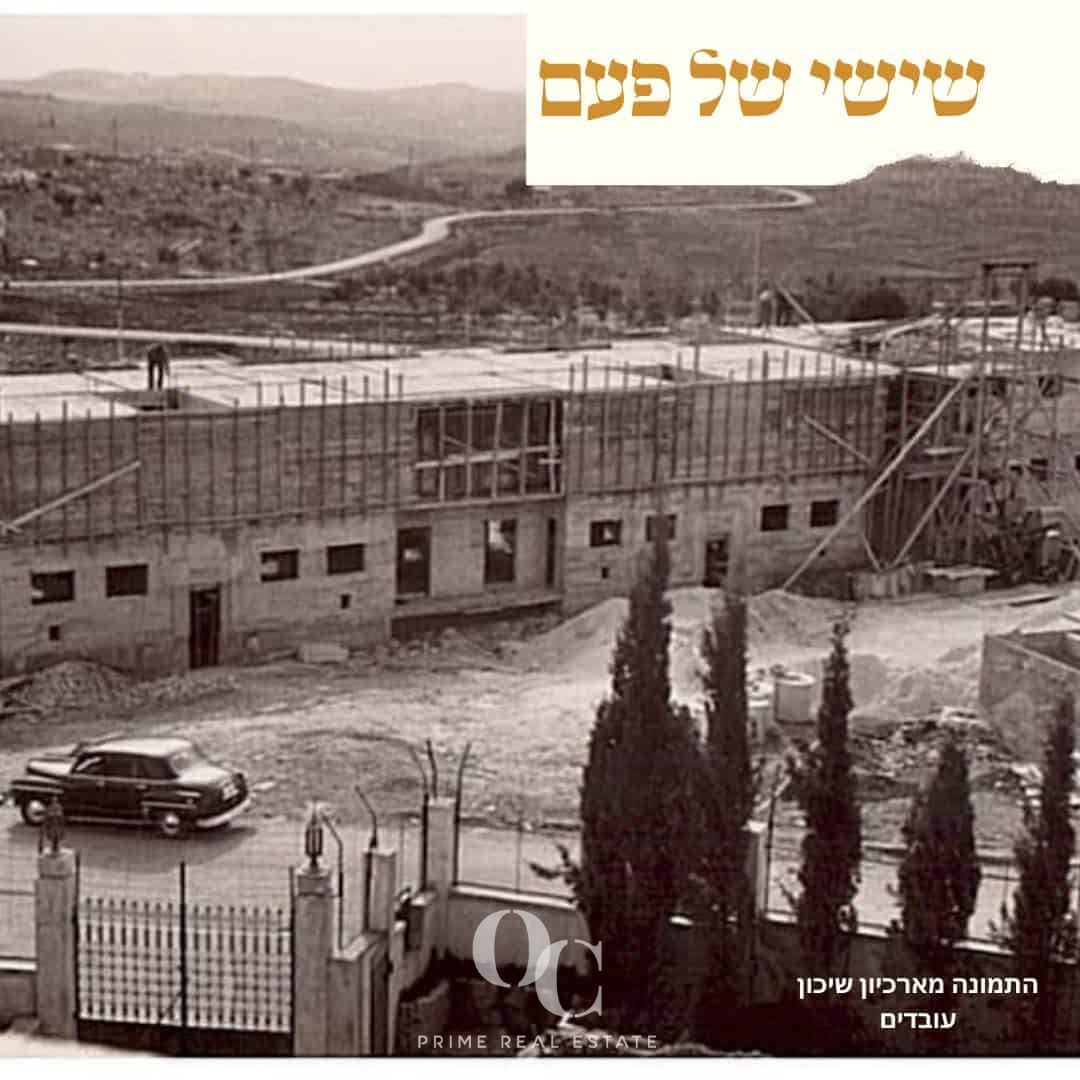
Another Once upon a Time in Jerusalem –
and this time, the construction of the “railway-style” housing blocks in Kiryat Moshe, at the beginning of what is today Kanfei Nesharim Street.
Kiryat Moshe was established in 1925 with the help of the “Mishkenot Moshe Montefiore Memorial Fund”, and that is where it received its name.
Before founding this neighborhood, the fund had also promoted the establishment of the neighborhoods Mazkeret Moshe, Yemin Moshe, Zikhron Moshe, and Ohel Moshe.
From Moshe to Moshe, none arose like Moshe.
The neighborhood was built on 112 dunams of land purchased by the fund’s representative, Professor David Yellin, for the price of 100 Israeli pounds.
This small neighborhood was founded under regulations defining it as a Jewish-Hebrew neighborhood near Jerusalem.
That’s how the first residents saw themselves, and that’s how they viewed its location – on the other side of the mountains of darkness, far, far from the city center.
Near Jerusalem – true pioneers who went out to live on the distant frontier.
By 1939, 79 families were living there in stone houses.
As demand grew, by 1941 the original residents understood that the number of inhabitants was about to rise.
It sounds unbelievable today, but the residents sent a letter to the Jerusalem Municipality requesting that the neighborhood be annexed and officially considered part of the city of Jerusalem.
In the late 1930s, the nearby neighborhood of HaMekasher was built in parallel, housing members of Jerusalem’s HaMekasher transportation cooperative, across the old bus depot at the foot of what is now Binyanei HaUma.
Nearby, the Me’onot Ovdim neighborhood was also established.
In Block No. 4, also known as the “Teachers’ Block,” lived among others:
* Minister of Education and Culture Prof. Ben-Zion Dinur
* The principal of the Hebrew Gymnasium
* The poet Yitzhak Shalev (and his son, author Meir Shalev)
* Israel Prize award winners
* Many other educational and academic figures
The neighborhood’s character slowly changed.
The small stone houses were replaced by long plaster apartment blocks, streets were given names, and in 1964, the Mercaz HaRav Yeshiva moved into the neighborhood.
Later, the Machon Meir Institute was established nearby, and the neighborhood’s character attracted the elite of the Religious Zionist community, alongside secular and Charedi residents who lived together in harmony.
Much water has passed under the bridge since then.
Today, the Red Line of the Jerusalem Light Rail runs alongside the neighborhood.
The HaMekasher housing blocks were completely demolished, and in their place two massive 25-story towers were built.
More homes in the neighborhood have been demolished and rebuilt, and a fast-moving urban renewal process is transforming this once-green and sleepy neighborhood into a major center of redevelopment in western Jerusalem.
To the west lies Har Nof, and to the north Givat Shaul, framing this Religious-Zionist and liberal neighborhood with surrounding Charedi communities.
And the city is changing before our astonished eyes.
This is our Jerusalem –
Rivers of pink champagne have flowed since the days when singers, writers, and professors lived in simple plaster apartment blocks with no elevator.
110 dunams of Jerusalem land purchased for 100 pounds.
A neighborhood built for the city’s transportation cooperative of the time.
And one Moshe Montefiore –
who climbed into his carriage, said enough for the horses, and left his mark on the city, still felt today, 120 years later.
A Shabbat Shalom to those far and near from Jerusalem ❤️
Photo: Shikun Ovdim Archive.