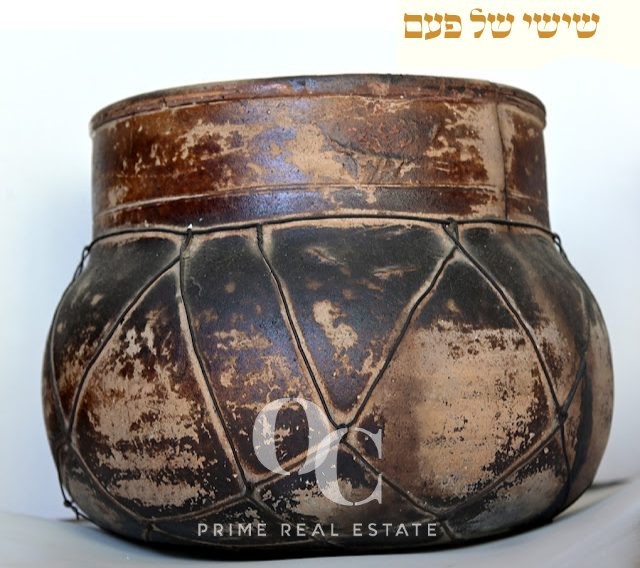
A pot of cholent for Shabbat in the neighborhood communal oven – another Once Upon a Time in Jerusalem.
There are certain aromas that can peel away decades of progress, asphalt, and concrete in an instant, carrying us back to another Jerusalem-a city of stone, spirit, and community.
Such was the scent of Friday afternoons in the narrow streets of the old neighborhoods. The fragrance of burning wood mingled with the heavy blanket of steam rising from dozens of dishes placed inside the “furnel”-the neighborhood communal oven.
In the photo: A clay cholent pot reinforced with iron wire so it could withstand a long night inside the communal oven.
In those days, when home kitchens were modest and modern ovens were a little more than a distant dream, the communal neighborhood oven was the beating heart of Shabbat preparations. It was usually housed in a cool stone basement or a low stone building, centered around a massive brick oven fueled by twigs, firewood, and almond shells.
Before the establishment of the State of Israel, fuel for heating ovens was both scarce and expensive-far beyond what the average family could afford.
The communal oven provided the perfect solution for Shabbat cooking, using firewood and charcoal brought to Jerusalem from Hebron and the orchards of the Sharon region.
As Friday approached, the alleyways became the stage for a fascinating parade-like event. Children and adults walked through the streets carrying long trays filled with braided challahs, cakes, and rising dough. But the highlight came just hours before Shabbat, when it was time for the cholent pots to have their time to shine.
From every courtyard and alley came heavy aluminum and iron pots. To prevent them from being mixed up, each pot bore a unique identifying mark-its own family “ID card”: a wire wrapped around the handle in a distinctive way, a colorful piece of cloth tied to it, or a deep engraving on the bottom. The baker-or the caretaker of the oven-figures in their own right, who could recognize every family’s pot at a glance, arranged them with remarkable skill and precision inside the enormous oven.
Dishes requiring less time were placed near the opening, while the heavy cholent pots were positioned deep inside, where they would slowly cook throughout Friday night.
The communal oven was far more than a practical solution; it was Jerusalem’s true melting pot. There, in the intense warmth of Erev Shabbat, Ashkenazi cholent sat beside Sephardic sachna, hearty stews filled with bones and legumes rested next to dark Jerusalem kugel.
The aromas blended together, soaked into the ancient stone walls, and became one unmistakable fragrance-not belonging to any single community, but to Jerusalem itself.
On Shabbat morning, as the sun rose over the sleepy city and the prayers of Musaf filled the air, the procession reversed. Children were sent once more, this time to bring the treasured pots home.
The pots were wrapped in old blankets to preserve their heat, and the journey home was made at a brisk pace, hands aching from the weight and the warmth, while the irresistible aroma of the cholent stirred everyone’s appetite until the ceremonial moment when the lid was finally lifted at the Shabbat table.
At that instant, when the stew revealed its deep, rich brown color-earned after an entire night nestled beside the pots of neighboring families-the true spirit of Jerusalem’s Shabbat came alive.
Those stone ovens disappeared long ago, yet their fragrance and the memories they hold, of shared community life, simplicity, and innocence, remain deeply embedded in the cracks of Jerusalem’s ancient stones.
Shabbat Shalom to those far and near, from Jerusalem.
Photo courtesy of the Dancho Arnon Collection.