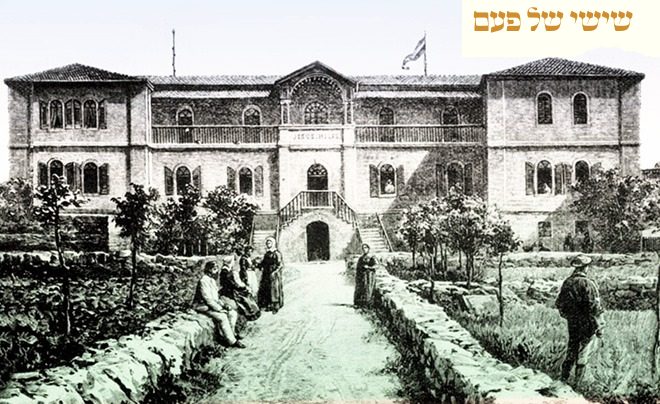
Beit Hansen, Talbiya – another remnant of old Jerusalem
Beit Hansen was established as a leper hospital in Jerusalem and is located in the Talbiya neighborhood, between Dubnov Street and today’s Gedalia Alon Street, on the grounds of the Moon Grove and near the Jerusalem Theatre.
For many years, the isolated building was a nightmare for Jerusalem’s children, and the ultimate threat used by parents – far more frightening than the warning that a policeman would come if you didn’t finish all the food on your plate.
Leprosy, a severe skin disease, is mentioned in the Torah. Those afflicted were socially ostracized and expelled from the camp.
Beit Hansen is named after the Norwegian researcher who identified the disease in 1873, though it was a different form of leprosy that also caused bodily and skin changes, brought about by a bacterium that Hansen himself discovered.
Because of the severe physical symptoms, lepers were shunned and expelled from the city for centuries, forced to live in isolated communities without support, surviving on alms.
The harsh sights of disfigured people, their bodies covered with sores, lying on street corners and begging for their livelihood did nothing to endear either the disease or those who suffered from it.
In Jerusalem at the end of the 19th century, most lepers lived in several isolated shacks near the walls of the Old City-crumbling dwellings built of stones and branches. They married within the community and were condemned to lives of suffering, isolation, and humiliation until 1865.
That year, Baroness Augusta arrived in the city. Shocked by the poverty and isolation endured by Jerusalem’s leper community, she decided to raise funds to build a hospital and inpatient center for them.
The first hospital was built outside the walls, at the edge of what was then the city and beyond the “Mountains of Darkness,” on what is today Agron Street, in a building that would later become the Lazarist Monastery. The old leper dwellings were demolished by the Ottoman authorities.
Overcrowding in the new hospital and the inability to separate severe cases from mild ones led to deaths among the patients. In their distress, they turned to the Moravian Church for help.
The church purchased land for the patients far from the Old City, in an isolated location, and thus Beit Hansen as we know it today was established.
The building was designed by the architects Conrad Schick and Theodor Sandel, German architects and Christian missionaries who were part of the Templar movement (about which I have written before). Schick’s son-in-law, a physician, managed the hospital.
The building was inaugurated in 1887, stood on 40 dunams of land, and was surrounded by a wall. It included trees and plants, vegetable gardens, and a poultry farm to allow the patients an independent, self-sustaining economy.
With the end of Ottoman rule in the city following defeat in World War I and the beginning of the British Mandate, Beit Hansen’s ties with Germany were severed. The site came under British control, received government funding, and the leprosy bacterium began speaking English with a British accent.
Patients who went for walks near the building encountered looks of horror from nearby residents, and for many years there was heavy pressure to relocate the leper hospital elsewhere.
With the establishment of the State of Israel and the expulsion of the British, the Arab patients who had been staying there left and moved to the leper hospital in the village of Silwan. Only Jewish patients remained at Beit Hansen.
In 1950, the building and the surrounding land were purchased by the Jewish National Fund and transferred to the management of the Ministry of Health, which continued caring for the remaining patients.
The Jewish mind never disappoints: in 1964, Dr. Yaakov Sheskin, a physician at the hospital who conducted various experiments there over the years, discovered the effect of the drug thalidomide on the leprosy bacterium, leading to a breakthrough in treatment. This discovery had a global impact and continues to influence leprosy treatment to this day, especially in developing countries.
In the 1980s, the building ceased to function as an active hospital and was converted into outpatient clinics.
In May 2009, it was decided to transfer the building to the Jerusalem Municipality, which designated it as a center for design, media, and technology.
In 2013, the building was renovated while preserving its unique and impressive character. Today it includes a cultural center, art galleries, cinema rooms, and the master’s degree department of the Bezalel Academy of Arts in various fields.
Only in Jerusalem—an over-the-top, steroid-fueled transformation along the timeline of a Jerusalem building that has seen it all:
leprosy from the days of Miriam and the expulsion of lepers from the camp; a disease that changed form into a bacterium discovered by a Norwegian scientist; lepers who lived in neglected homes by the Old City walls and then moved to the edge of the city of that time, today’s Agron Street; Muslim Ottoman rule; German Christian missionaries expelled by stern British rulers, who were themselves expelled by Jewish fighters for independence and freedom who returned to their original home after 2,000 years of exile; a people who produced generations of scientists and world-changing individuals who, among other things, discovered the cure for leprosy that saves lives to this day in all four corners of the globe.
Frightened children encountering lepers in the alleys of Talbiya would one day become master’s students at the Bezalel Academy of Arts—named after Bezalel, the interior designer of the Temple. Old stones quarried from the hills of Jerusalem, in a 139-year-old building, have seen it all.
And if the stones could speak…
This is our Jerusalem, and this is why we so love the magic of the most special city in the world.
Shabbat shalom to those near and far, from Jerusalem.
The photograph is from the Roni Ellenblum Collection for the History of Jerusalem; image processing by Tamar Hayardeni.