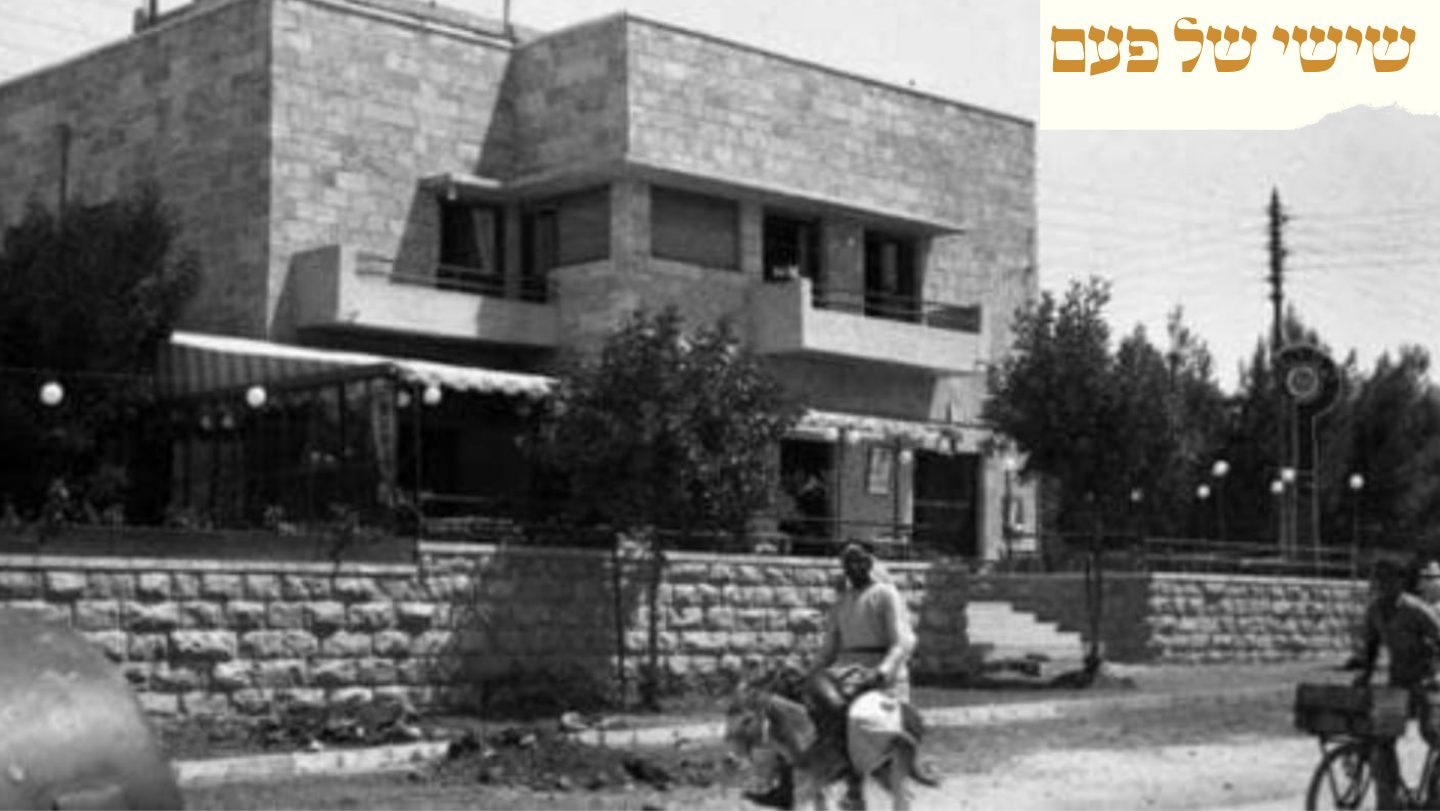
The Molcho House, at the corner of Ramban Street 20 and Ibn Gabirol Street, is one of the most iconic properties in the Rechavia neighborhood.
The building was erected on what was once considered the finest location in Rechavia, long before traffic jams and car horns, right beside the neighborhood tennis court, today known as Giraffe Garden or Eliezer Yellin Garden, named after the renowned architect whose own home was built nearby at 14 Ramban Street. That house was the very first to be constructed in Rechavia.
The building at 20 Ramban Street was completed in 1929 by Yitzhak Raphael Molcho, a fascinating Jerusalemite figure: historian, journalist, businessman, and also the mukhtar (community head) of Rechavia.
Before the building rose, the site held a solitary shack used as a storage facility for film reels belonging to Molcho’s distribution company. Because the reels were highly flammable, they were kept at a distance from residential areas.
Molcho was born in Salonika, then under Ottoman rule, and was a descendant of Rabbi Yosef Molcho. When Salonika came under Greek control, Molcho, already wealthy and well-connected, worked tirelessly to promote Jewish immigration to the Land of Israel and to advance the Balfour Declaration in Greece, Italy, and Spain.
In 1919, Molcho immigrated to the Land of Israel and settled in Jerusalem. He married Simcha, the daughter of Yitzhak Yehuda Cohen, who was involved in land acquisitions and had purchased the lands of Rechavia from the Orthodox Church, together with several other families.
As the neighborhood’s mukhtar during the British Mandate, Molcho initiated the naming of Rechavia’s streets after the great figures of Spain’s Jewish Golden Age. Thanks to him, streets were named for Ibn Ezra, Rabbi Moses ben Maimon (Maimonides), Abarbanel, and many others.
In 1935, a second floor was added to the house. It served as the Molcho family residence, housed the offices of his company, and contained a large library, today displayed at the nearby Ben-Zvi Institute.
The Fifth Aliyah, the “Yekke” immigration from Central Europe, was at its peak, and on the ground floor Café Rechavia opened its doors.
This was no ordinary café. It was an institution.
Unlike the bohemian cafés of the city center, such as Ta’amon or Atara, Café Rechavia was a bastion of bourgeois restraint and solidity. Giants of the era sat here: S.Y. Agnon, who would walk from his home in Talpiot (and later from Rechavia), the philosopher Martin Buber, and British Mandate officers who cherished order and impeccable cleanliness.
If the walls at the corner of Ramban and Ibn Ezra could speak, they would speak three languages: Hebrew, the language of intellectuals; English, spoken by British officers; and above all, precise, carefully enunciated German, the tongue of professors.
Yet Rechavia’s tranquility was deceptive. The café was also famous for the weekend dance orchestra led by Yaakov (Jack) Shamir. The music and dancing on Shabbat drove the nearby religious neighbors from the Ezra youth movement nearly mad. More than once, the café terrace became the scene of heated protests over the character of Jerusalem, a debate that still sounds familiar today, almost ninety years later. For there is nothing new under the sun, and nothing quite like a good argument among Jews, apparently our national sport, one in which we excel.
Architecturally, the building was a classic example of the International Style (Bauhaus), adapted to Jerusalem: clean lines, flowing balconies, and the use of Jerusalem stone. For many years it stood at just two stories; only later were additional floors added, with careful attempts to preserve the delicate balance between commerce and residential life.
The building also knew harder days. Many remember it from a less glamorous chapter, when the legendary ground floor housed a supermarket that buried its historic elegance beneath shelves of canned goods and juice bottles.
But as with good Jerusalem real estate, patience pays off.
A Jerusalem entrepreneur purchased the neglected building, and in 2020 the local planning committee approved the construction of a new hotel. Three new floors and twenty-two guest rooms were added, transforming the building into a boutique luxury hotel. The original stone façade was meticulously preserved, the wooden windows restored, and on the ground floor a café and kosher restaurant reopened. The hotel is operated by the Machane Yehuda group led by Asaf Granit, aiming to restore its former glory, with less strudel and more polenta, under the supervision of the Chief Rabbinate.
The stones of the building, once saturated with Ladino, Hebrew spoken in a heavy German accent, and the polished English of Mandate officers, are slowly adjusting to the rolling sounds of American English and finding comfort in the strains of Yiddish spoken by mothers watching their young children in Giraffe Garden.
This is our Jerusalem.
A polymath from Salonika, also a ritual slaughterer and inspector, who caught the Zionist bug and immigrated to the Land of Israel; who married the daughter of a land buyer for the Palestine Land Development Company; who acquired the best plot in what was then the neighborhood; who served as Rechavia’s mukhtar and named its streets after the giants of Sephardic Jewry; who distributed films from major American companies stored in a remote shack that became his home, that became Café Rechavia; which hosted Yekkes, thinkers, and officers of a foreign army who later returned, battered, to their rainy homeland; whose one grandson became a man of secrecy on special missions for the prime minister, and whose other grandson is a talented architect watching in wonder as the city transforms. While on the old elite tennis court of Jerusalem, children of religious immigrants from Jewish communities around the world now play, alongside polenta, fish tartare, and Jerusalem bagels with za’atar from a tattooed local chef.
A never-ending “Chad Gadya,” that only the most extraordinary city in the world knows how to provide.
One building. One hundred years. And a living history, constantly being rewritten before our eyes.
And if the stones could speak…
Wishing a peaceful Shabbat to those far and near Jerusalem.
Photographer unknown.