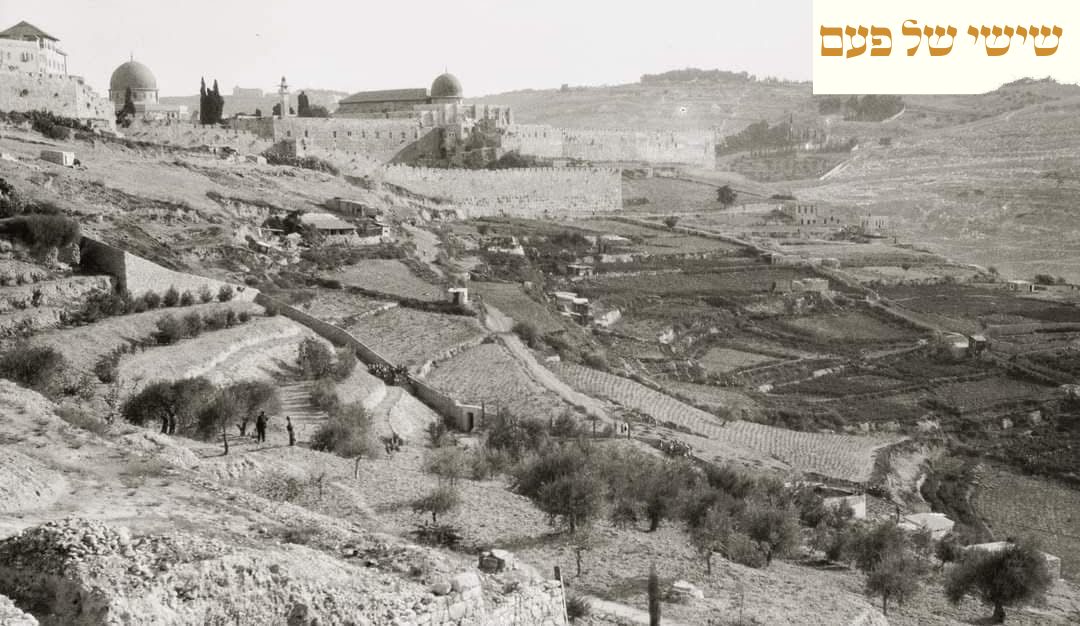
The City of David and the Temple Mount in 1900, Another Once upon a time in Jerusalem
The City of David lies outside the walls and southeast of the Old City basin, on what is known as the Ophel ridge, its name meaning a raised or elevated place.
The City of David is the beginning of ancient Jerusalem, the place where everything started.
Why, then, was the birthplace of the most important city in the world established in a low-lying area and not on the hilltop, as was customary for other ancient cities in the world?
When King David became king of all Israel, he decided to move the nation’s capital from Hebron to Jerusalem. He conquered the city and began the new Jewish settlement there.
In antiquity, long before rockets and missiles, the range of weapons was limited. The steep slope of the Kidron Valley to the east and the Tyropoeon Valley to the west enclosed the site and provided natural defense. Only the northern slope remained exposed, and it was there, on the hilltop, that the Temple would eventually be built.
The city was established adjacent to the most crucial resource of the time: the Gihon Spring, the sole water source for Jerusalem.
The soil in the valley floors, enriched over time from runoff down the slopes, was fertile and ideal for agriculture.
The City of David covered an area of roughly 60 dunams.
As preparation for the future Temple, King David brought the Ark of the Covenant and purchased the area now known as the Temple Mount to build an altar on the hilltop—then still outside the city limits.
In the days of King Solomon, David’s son, the First Temple was built, and the Temple Mount was annexed to Jerusalem on its northern side, together with the royal palace. The city now expanded to about 130 dunams.
These were the glory days of the ancient people of Israel, and the story of the city is the story of the Jewish people through the generations.
After Solomon’s death, the kingdom and the nation split into the kingdoms of Judah and Israel, and Jerusalem remained the capital of Judah.
From the moment division and disunity took hold, the people of Israel suffered hardship, conquest, exile, the destruction of the First Temple, and the devastation of the City of David and all of Jerusalem. The exile of the Ten Tribes followed, marked by blood, death, and many tears.
With the return to Zion after the Declaration of Cyrus, the Second Temple was built by the exiles returning from Babylon, who had long wept by its rivers and remembered Jerusalem in its days of unity. The nation once again prayed in the Temple.
Later, King Herod (the original, not the imitator) renovated and enlarged the Temple, transforming it into a masterpiece of splendor to win the favor of the Jewish populace and to glorify his own name.
The Talmud says that one who has not seen Herod’s Temple has never seen a beautiful building in his life.
The city grew and flourished: the wealthy lived in the Upper City near the Temple Mount and today’s Old City, while the poor and working classes lived in the older City of David at its foot.
Yet the people of Zion seemingly did not learn from the past. Internal struggles, factionalism, and bitter rivalries weakened and fragmented the nation. The attempt to rebel against the Romans, paired with civil war among Jewish factions, led to the destruction of the Second Temple, to bloodshed, death, and tears, and to a long and unbearable exile.
In 1882, impoverished Jews from Yemen arrived in the Land of Israel with no shelter and no possessions.
Jewish community leaders and benefactors purchased a plot of land for them on the slopes of the Kidron Valley, and in 1884 the village of Kfar Hashiloach was founded near the spring, with the hope of cultivating the fertile soil for the benefit of Jerusalem’s Jewish residents.
In a photograph from 1900, the City of David appears desolate and ruined. The slopes that had once been vibrant and full of life look abandoned and used mainly for basic agriculture by local inhabitants and by the residents of Kfar Hashiloach.
In 1920, local Arab rioters attacked the Jewish residents of Kfar Hashiloach, killing and causing significant damage to the small community, which gradually declined.
In 1936, rioters once again assaulted the remaining Jews, killing and looting, and the village was ultimately abandoned.
Today, on the historic slopes of the City of David, the dense Arab neighborhood of Silwan has grown, built close to the walls and the Temple Mount.
Anyone visiting the area today would struggle to recognize the once-green, open hillsides southeast of the Temple Mount.
Various organizations now work to reclaim early Jewish property and to purchase homes and land from Arab residents of Silwan in order to renew the ancient Jewish presence in the area.
This is our Jerusalem, the city that has served as the measure, the history, and the barometer of Jewish life throughout the generations.
The painful lesson from the destruction of both Temples, brought on by internal strife, factionalism, and senseless hatred, has yet to be fully learned.
Today, once again, we are experiencing dark days of division, hostility, and infighting within the nation, in a country that has achieved the unimaginable in 78 years of independence, and among a people scattered among the nations who returned from two thousand years of painful, blood-soaked exile that continues to this day.
Whether we have learned the lesson as a people will be answered only by the future.
A peaceful Sabbath to those far and near from a Jerusalem torn by internal struggles and factionalism, with the genuine hope that the lessons of past destruction will be learned in classrooms and history lessons, and not on living flesh.
Photograph: Library of Congress.