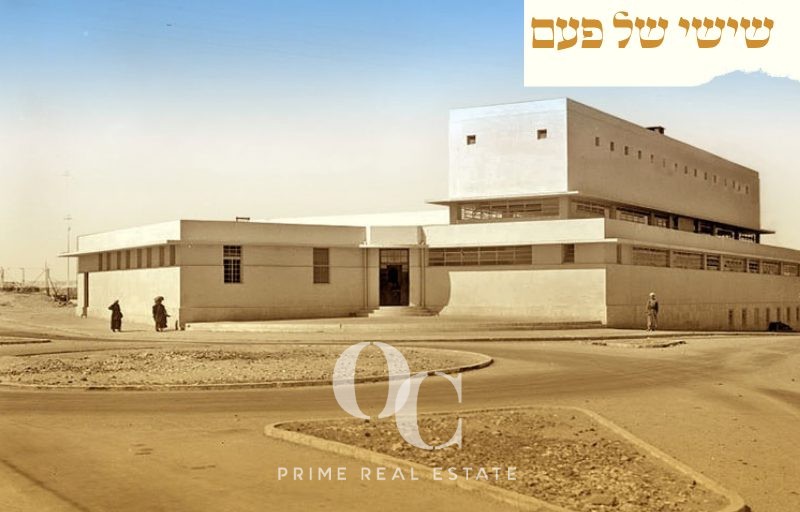
The Government Printing House on Hebron Road, Once Upon a Time in Jerusalem.
At the junction of Hebron Road and David Remez Street, directly opposite Jerusalem’s historic railway station – today’s First Station complex – beside the Khan building and at the foot of Bible Hill, stands an impressive stone building.
Most Jerusalemites pass it every day without knowing one of the city’s most fascinating stories of history and real estate transformation.
The year was 1937.
The British Mandate authorities in Palestine decided to establish a modern government printing centre that would bring all the empire’s paperwork and bureaucratic needs under one roof.
The task was entrusted to Austen St. Barbe Harrison, the chief British architect of the Public Works Department (PWD), whose work includes some of Jerusalem’s most iconic stone buildings: the Rockefeller Museum, Government House and the Central Post Office on Jaffa Road.
Harrison designed the building in the International Style, commonly associated with Bauhaus architecture: clean horizontal lines, long ribbon windows to admit natural light and ventilate ink fumes, and a practical industrial layout.
Its appearance recalled a large ship or a modern industrial fortress.
He finished the building in white plaster, in the style of Tel Aviv’s White City, departing from the regulations requiring Jerusalem stone cladding and from the other buildings constructed in Jerusalem during the British Mandate.
The location was no coincidence. Its immediate proximity to the railway station provided an ideal logistical arrangement.
Huge rolls of paper weighing tonnes, barrels of ink and heavy printing machinery imported from Britain were unloaded at Jaffa Port, loaded onto railway carriages and brought directly into the building along a dedicated siding.
Within these stone walls, under heavy security and strict secrecy, banknotes, the British Mandate’s official newspaper – the Palestine Gazette – government orders, confidential maps, bonds and postage stamps were printed.
From here, formally dressed British officials managed the records and laws that shaped the country.
With the end of the Mandate and the establishment of the State of Israel in 1948, the building’s commanding position overlooking Hebron Road, the Hinnom Valley, Baka and Abu Tor made it a crucial strategic military location. It was captured by Haganah fighters.
The building served as a forward military position for the Etzioni Brigade, facing the Jordanian Legion forces entrenched in Abu Tor and on the slopes of Mount Zion.
Following the establishment of Israel, the building passed into the hands of the young state and became the Government Printing House.
The same printing presses that had produced Britain’s White Paper restrictions began printing the State of Israel’s official gazette, its first banknotes and Hebrew postage stamps, identity cards and government forms, and later, national lottery tickets.
The compound was enclosed by high barbed-wire fences and protected by armed guards around the clock. The smell of printing ink, glue and fresh paper filled the Hebron Road junction.
The years passed, technology advanced, and in the 1980s the Government Printing House moved to new premises in Givat Shaul, and later to the Atarot industrial zone.
The historic building on Hebron Road was abandoned. It stood empty and neglected for many years and, like many buildings in the city, nearly fell into ruin.
But in Jerusalem, history always finds a way to reinvent itself.
In the 1990s, entrepreneur and high-tech magnate Erel Margalit acquired the abandoned compound for his venture capital fund.
Through meticulous restoration by Plesner Architects, it became the JVP Media Quarter – a hub for high-tech companies, venture capital funds and leading start-ups.
The halls that once housed Britain’s industrial printing presses were transformed into offices for Israeli technology companies and homegrown Zionist start-ups.
Around it, the entire area experienced a remarkable renaissance.
The old railway station was restored and became the lively First Station complex.
The railway tracks became the green Train Track Park, linking Baka, the German Colony and Mekor Haim. Properties on the surrounding streets became some of the most desirable and expensive in the city.
In Jerusalem, buildings and real estate are valued not only for the quality of their construction, but also for the history embedded in their foundations. Exploring the city’s architectural heritage, together with a love of Jerusalem nurtured over decades of professional work, reveals time and again how every stone carries a soul, a memory and an entire lifetime.
The steam train from Jaffa stopped puffing smoke long ago.
The formally dressed British officials are gone, the Mandate’s heavy machinery has fallen silent, and the Jordanian Legion soldiers who dug in just a few hundred metres from the building have faded into the pages of history.
In their place are brilliant young Israelis developing technology for the world, in the same stone building where the first steps of the state were once committed to paper.
This is our Jerusalem. Empires rise and fall, governments come and go, and one enduring people continues to grow, build, innovate and create new life from ancient stones.
Shabbat Shalom to those far and near, from Jerusalem.
Photograph: The Matson Collection of the American Colony photographers, processed by Tamar Hayardeni.